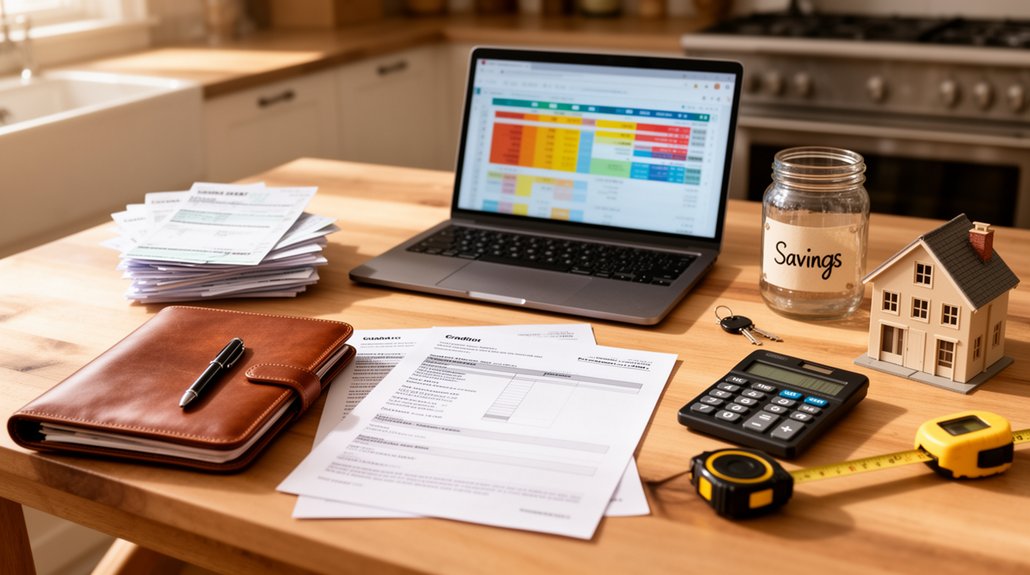
You probably don’t know that many lenders must verify not just your income, but the source of recent deposits under anti‑money‑laundering and mortgage underwriting rules. If your bank activity can’t be documented, your approval timeline can stall. Start by mapping your gross income, recurring debts, and credit utilization to the DTI and reserve targets lenders use. Then set a payment budget that includes taxes, insurance, and HOA dues—before you shop rates. Next comes the part most buyers miss.
Key Takeaways
- Check your mortgage credit scores and dispute report errors early, since small score changes can affect rates and approval.
- Calculate a realistic budget using full housing payment (PITI+HOA) and stress-test with a 10% buffer for utilities and maintenance.
- Reduce debt to improve DTI, targeting total DTI near 43% and keeping revolving utilization below 30%.
- Save for cash to close: down payment, lender and title fees, prepaid taxes/insurance, plus inspection, appraisal, moving, and repair reserves.
- Gather documentation (W‑2s/1099s, paystubs, bank statements, ID) and avoid new credit, large unexplained deposits, or job changes before closing.
Know the Lender Numbers Before Buying a Home

Before you start touring homes, you should know exactly how a lender will size your loan—because underwriting runs on defined ratios, documented income, and credit-driven pricing, not estimates. You’ll be measured on debt-to-income (DTI): most programs cap total DTI near 43%, with some allowing higher if compensating factors exist.
Verify your stable monthly income with W‑2s, paystubs, or tax returns, and count only debts that report or must be paid.
Next, map your full monthly housing payment: principal, interest, taxes, insurance, and any HOA dues.
Compare Loan options (conventional, FHA, VA, USDA) against required down payment, mortgage insurance, and reserve rules.
Ask for a Loan Estimate to see Lender fees, points, and third‑party charges, so your budget matches reality.
Check Your Credit Score Before Buying a Home
Why does your credit score matter so much when you’re buying a home? Mortgage pricing is risk-based: even a small score gap can shift your rate, payment, and approval odds. Most lenders pull FICO models, and you’re entitled under the FCRA to free reports from each bureau, so start there before you shop.
Then check your mortgage scores, since they can differ from the score in your banking app.
Use credit monitoring to catch surprises early: wrong balances, duplicate accounts, or late payments you didn’t recognize. Dispute errors with the bureaus in writing and keep records; timelines and notices are regulated.
For score improvement, focus on on-time payments and keeping revolving utilization low. You’re not alone—this checklist puts you on the same path as prepared buyers.
Pay Down Debt to Improve Your Mortgage DTI
Because lenders underwrite to your debt-to-income ratio (DTI)—the share of your gross monthly income already committed to debt—paying down balances can raise your approval odds and lower your risk-based pricing.
Aim to bring revolving utilization below 30% (lower is better) and reduce monthly minimums that feed DTI. Start with high-APR credit cards, then tackle installment loans where a payoff removes a payment line entirely.
Consider Debt consolidation only if the new loan lowers your rate and payment without extending costs; lenders will still count the obligation.
Use savings strategies that don’t add new debt: automate extra principal payments, apply windfalls, and pause nonessential subscriptions.
Keep documentation—statements and payoff letters—so your community of advisors (loan officer, housing counselor) can verify updates quickly.
Build a Mortgage-Ready Monthly Payment Budget

Even if you qualify on paper, you’ll stay mortgage-ready only if your monthly budget can absorb the full housing payment—principal and interest, property taxes, homeowners insurance, HOA dues, and any mortgage insurance—without squeezing essentials or emergency savings. Treat the payment as a fixed line item, then stress-test it: run a 10% buffer for utilities, maintenance, and rate or escrow changes.
Align your plan with common underwriting expectations (like keeping total debt-to-income within lender limits) so you don’t pass approval but fail reality. Use Financial planning to map take-home pay, recurring debt, and true living costs.
Apply Budgeting strategies: automate savings, cap discretionary spend, and track categories weekly. When you can hit the target payment for three months, you’re ready—and you’ll feel part of the prepared buyers’ club.
Plan Cash to Close and Prep Preapproval Documents
Before you tour homes, you need a cash-to-close estimate and a preapproval file that can survive lender verification. Start with a worksheet: down payment, lender fees, title/escrow, prepaid taxes and insurance, and a 1%–3% closing-cost range based on local averages.
Add reserves for a Home inspection and a property appraisal, plus moving and immediate repairs so you’re not stretched at signing.
To meet common Ability-to-Repay and AML checks, gather two years of W‑2s or 1099s, recent paystubs, two months of bank statements, and ID. Explain large deposits in writing and avoid new credit pulls, cash deposits, or job changes.
When your documents match your budget, you’ll shop with confidence and credibility.
Conclusion
You’ve done the not-so-glamorous work: you’ve checked lender ratios (DTI and LTV), reviewed your credit, and trimmed balances to keep utilization lean. You’ve built a payment budget that fits underwriting rules, not wishful math, and you’ve mapped cash-to-close—down payment, closing costs, reserves—so there aren’t any “surprises” at the table. Now keep inquiries quiet, document every deposit, and hand lenders clean files for a smoother, compliant preapproval.
About the Author