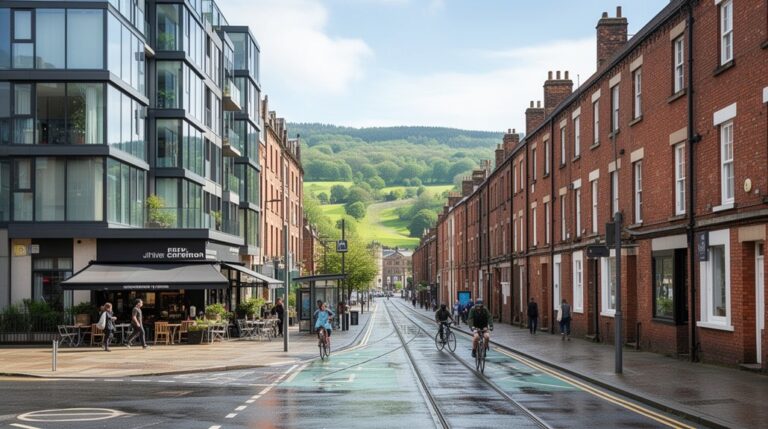
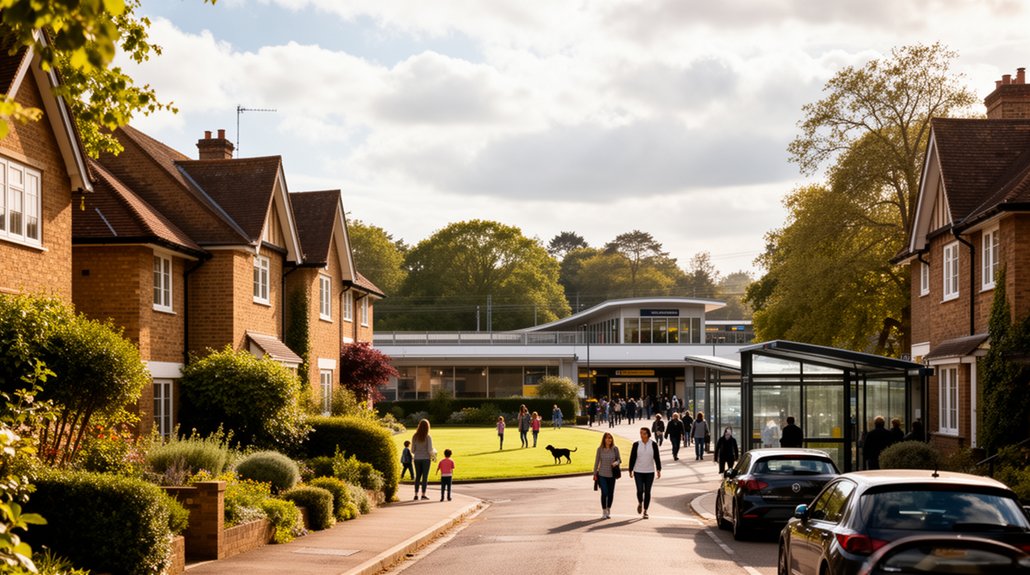
You might assume you’ll sacrifice fast London access if you prioritise space, but Amersham lets you keep both. You get two credible commuter options—Metropolitan line and Chiltern Railways—plus larger-than-average homes around the Hill and the fringes, where plots and extension potential skew higher. Add conservation character, school-driven demand, and green-space proximity, and the trade-offs start to look different—especially once you compare Old Town vs Hill pricing and station-day realities.
Key Takeaways
- Amersham combines fast London rail links with larger-than-average family homes, making it ideal for commuters seeking more space.
- Amersham-on-the-Hill offers walkable access to the station, bigger 1930s–modern houses, and driveways, suiting hybrid working and families.
- Old Amersham delivers historic charm and amenities, but higher price-per-square-foot, tighter plots, and conservation limits reduce space value.
- Limited new supply and strong rental demand support price resilience, with well-presented homes selling quickly and only modest discounts.
- Chilterns-edge green space and trail access enhance weekend lifestyle appeal, and walkable routes can simplify last-mile commuting.
Is Amersham a Good Place to Buy in 2026?
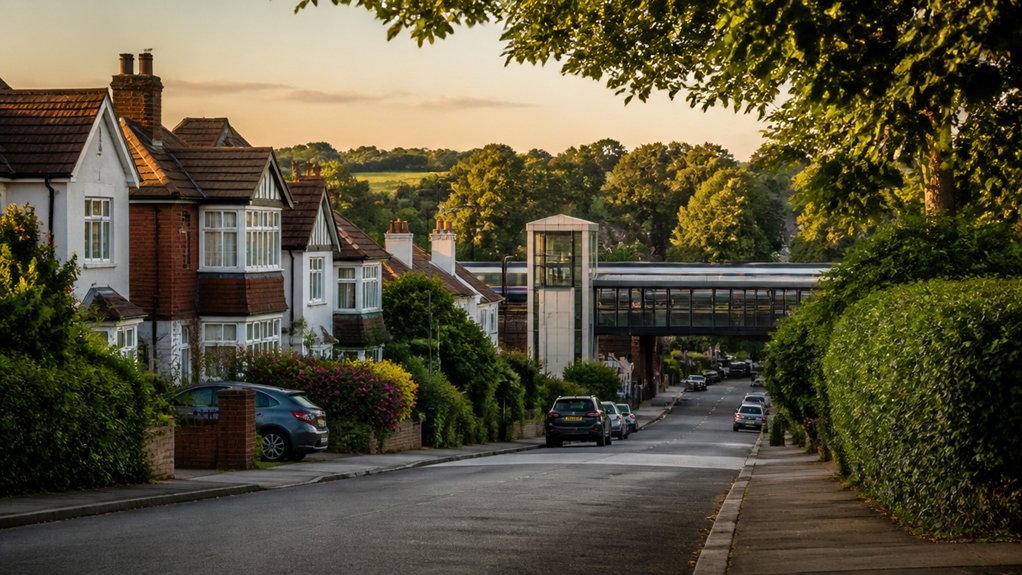
Why has Amersham stayed on so many 2026 buyer shortlists? You’re seeing a rare mix: commuter-speed rail, larger-than-zone-average floorplans, and a supply pipeline that’s tight enough to support pricing, yet active enough to keep choice moving.
You can track confidence in days-on-market holding firm for well-presented homes, while discounting stays contained versus wider Home Counties norms.
If you’re weighing property investment, you’ll like the rental depth from London-linked professionals and downsizers who want space without losing connection.
You also benefit from targeted urban renewal—public-realm upgrades, retail churn toward independents, and energy-efficiency retrofits that lift street-level appeal.
Buy here and you’re not just purchasing a house; you’re joining a market that rewards careful, long-hold ownership.
Amersham Areas: Old Town vs the Hill
Although both sit under the same postcode badge, Old Amersham and Amersham-on-the-Hill behave like two distinct micro-markets in 2026.
You’ll typically pay a premium in the Old Town for Historic architecture, tighter conservation controls, and smaller plots, so price-per-square-foot often runs higher even when overall floor area’s modest. Stock turns slower, and buyers compete for character homes with limited parking.
On the Hill, you’re closer to the station and larger 1930s–modern family houses, so you often get more square footage and driveways for comparable budgets. You’ll also see steadier transaction volumes and more extensions already “done.”
Whichever you choose, you’ll plug into community events quickly—schools, clubs, and local networks help you feel known, not just housed.
Where Amersham Feels Most Like a Village
If you’re chasing that “proper village” feel in Amersham, you’ll usually find it strongest where daily errands stay walkable and the street scene stays consistent year-round—think a tight core of independent shops, pubs, schools, and community venues within a 10–15 minute stroll.
Track footfall around the High Street/market areas at peak commuter times and weekends: you’ll notice steadier activity, which keeps cafés, services, and clubs viable.
You’ll also feel Village charm most where green edges, churchyards, and small squares create natural meeting points, not just pass-through routes.
Plug into Local traditions—seasonal fairs, school fêtes, and pub quizzes—and you’ll build familiarity fast because the same faces reappear weekly.
For buyers, that repeatable routine is the real village signal.
Amersham Homes: Terraces, Semis, Detached, New-Builds
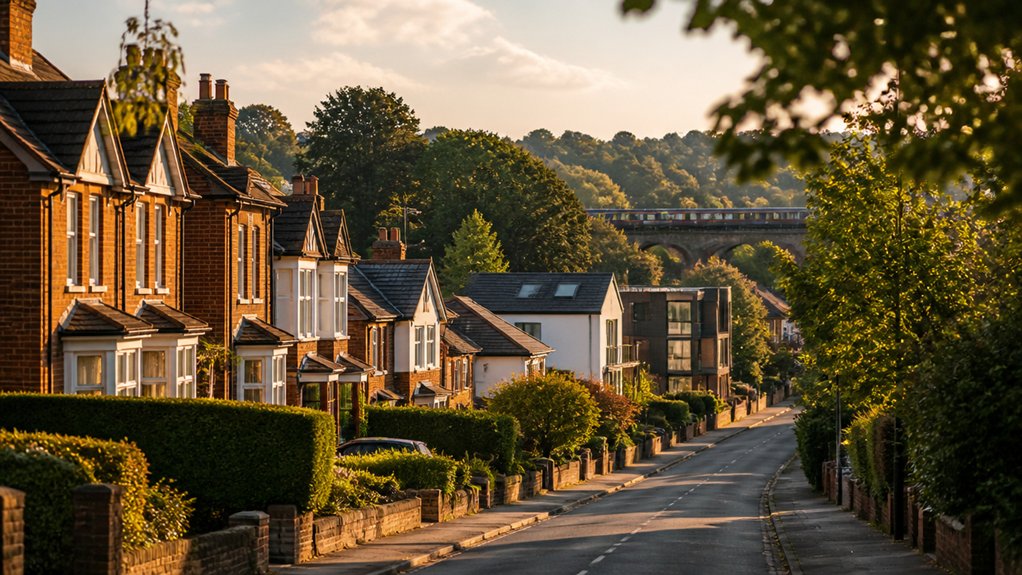
Because your commute and space needs usually dictate the brief, Amersham’s housing stock splits cleanly between character terraces in the Old Town, 1930s–1970s semis in established family roads, larger detached homes on greener, lower-density plots, and pockets of modern new-builds designed for low-maintenance living.
If you’re drawn to Historic architecture, you’ll find period detailing, tighter plots, and walkable access to pubs, cafés, and the station.
If you want family functionality, semis often deliver wider frontages, off-street parking potential, and adaptable loft/side-return scope.
Detached options typically prioritise privacy, garden depth, and home-office flexibility, suiting hybrid schedules.
Modern developments appeal if you value predictable running costs, integrated storage, and community-minded layouts.
Whatever you choose, you’ll buy into neighbourly streets and clubs.
Amersham Prices: What You Pay by Area
When you compare Amersham prices by neighbourhood, you’ll see clear tiering between Old Amersham character stock, Amersham-on-the-Hill convenience, and the more value-led edges near Chesham, Little Chalfont, and Great Missenden.
You pay up where you get walk-to-Metropolitan/Chiltern links, top catchments, larger plots, and period finishes.
You pay less where you trade for smaller footprints, busier roads, or longer station runs.
Use average sold-price bands and price-per-square-foot by micro-area to spot what’s genuinely expensive versus what’s simply well-presented.
Average Prices By Neighbourhood
Three micro-markets dominate what you’ll pay in Amersham: the heritage core around Old Amersham, the commuter-friendly hub near Amersham-on-the-Hill and the station, and the greener, larger-plot pockets on the town’s edges (including areas feeding Little Chalfont/Chesham Bois).
In Old Amersham, typical sold prices cluster around £900k–£1.3m, with period cottages and lanes that keep local history visible and pull you into community events.
Around the station, you’ll more often see £650k–£950k for modern houses and apartments, with faster turnover and sharper pricing.
On the fringes, family homes on bigger plots commonly sit at £1.0m–£1.6m, especially toward Chesham Bois.
Expect variation by condition, not postcode alone.
Cost Drivers By Area
Although headline averages help you benchmark, Amersham’s pricing shifts mainly on micro-factors: walk-time to the Metropolitan/Chiltern line, conservation constraints in Old Amersham, school catchment pull (Dr Challoner’s and local primaries), and plot fundamentals like frontage, depth, and scope to extend.
In Amersham-on-the-Hill, you’ll usually pay a station premium for turnkey semis and modern apartments; demand tightens near shops and cafés where neighbours actually linger.
In Old Amersham, period character adds value, but zoning regulations and listed-building consent can cap uplift from renovations.
In Chesham Bois, larger plots and leafy streets lift £/sq ft, especially for detached homes with garages.
Factor Property tax bands into your ceiling, and price in extension risk: slope, access, and drainage can swing quotes fast.
Where Amersham Is Best Value (and Why)
If you’re weighing Amersham against pricier commuter hotspots like Beaconsfield or Gerrards Cross, the best value typically shows up where you still get a walkable rail link and larger floor area per pound.
Target Amersham-on-the-Hill’s 1960s–1980s streets and selective pockets of Chesham Bois edges: you’ll often find 10–20% more internal space for similar budgets versus headline roads near top schools.
You’ll also avoid the Old Amersham premium, where Historical architecture and conservation constraints push pricing per sq ft up.
For buyers who want community, the sweet spot sits near shops, parks, and the annual calendar of local festivals, which supports resale demand.
Prioritise plots with off-street parking and room to extend—those metrics protect value.
Amersham to London: Tube vs Chiltern (Times + Costs)
Value in Amersham doesn’t stop at square footage—it shows up in your weekly commute maths, because you can choose between the Metropolitan line from Amersham station or Chiltern Railways from nearby Amersham/Chalfont & Latimer for faster runs into London.
For Commuter convenience, your Travel time comparison is straightforward: the Met typically takes about 60–75 minutes to Baker Street, plus onward hops; it’s one fare system, predictable, and good for all-zone flexibility.
Chiltern is the speed play: around 35–45 minutes to Marylebone from Amersham or via Chalfont & Latimer, often feeling more “mainline” in pace.
Cost-wise, TfL pay-as-you-go caps can suit frequent Zone 1 trips, while Chiltern season tickets can win if you’re in most weekdays.
Station Realities: Parking, Peak Trains, Walkability
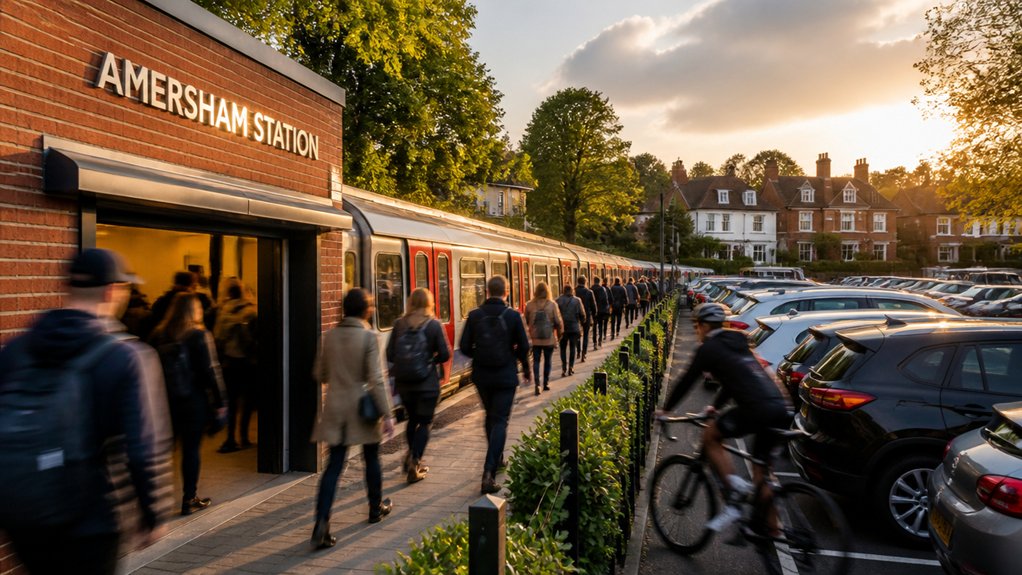
Because the commute only works when the station does, you’ll want to price in three on-the-ground variables at Amersham and nearby Chalfont & Latimer: car parking capacity (and how early it fills), peak-hour train frequency/reliability, and whether you can realistically walk or cycle from home without adding a “last-mile” headache.
Parking challenges are real: arrive after 7:30–8:00 and you’ll often be hunting, so test a typical Tuesday, not a quiet Friday.
If you can walk, you’ll protect your timeline and feel part of the commuter rhythm.
On service, you’ll see frequent Metropolitan line options, but factor in Peak train delays and platform crowding; build a 10–15 minute buffer.
Finally, map gradients, lighting, and cycle storage—small details decide daily comfort.
Amersham Schools Families Target (and Catchments)
Where do Amersham’s school-driven premiums actually show up? You’ll see them map tightly to school catchment areas, especially around the most consistently sought-after primaries and the secondary options families shortlist first.
Agents price in certainty: a house that sits clearly inside a preferred catchment often trades faster and can command a measurable uplift versus an equivalent home a few streets out.
To compete, you’ll need to treat boundaries like data, not hearsay. Check the latest admissions criteria, distance cut-offs, and feeder patterns, then stress-test your shortlist against year-to-year variability.
If you’re planning long-term, you’ll also value nearby family friendly amenities that support school runs and after-school logistics. When you buy into the right micro-area, you’re joining the same cohort of committed, settled households.
Lifestyle and Green Space: Shops, Cafés, Walks, Weekends
You don’t just buy square footage in Amersham—you buy a high-frequency lifestyle anchored by independent shops and cafés that keep weekday spend local and footfall steady.
You can walk off the workday fast, with woodland routes and open green space close enough to make “after-school” and “after-train” realistic, not aspirational.
And when the weekend hits, you’ll find the market-value sweet spot: plenty to do on your doorstep without paying London leisure premiums.
Independent Shops And Cafés
How quickly can a market town feel like a neighbourhood? In Amersham, you’ll notice it within a week of errands.
The High Street and Old Amersham cluster independent retailers—bakers, butchers, wine merchants, interiors, and bookshops—so you can shop locally without planning. That convenience matters to buyers: daily footfall supports stable trading, which protects the streetscape you’re buying into.
You’ll also plug into café culture that works for modern schedules: quick espresso runs, laptop-friendly corners, and school-run meetups.
Spend £6–£12 and you’re part of a familiar rota, not just a customer. Evening dining stays walkable, so you can keep midweek social without driving.
If you want belonging with practical value, this is your baseline.
Woodland Walks And Weekends
In Amersham, woodland isn’t a “nice-to-have”—it’s a weekend default that consistently pulls buyer demand toward homes within easy reach of the Chilterns AONB. When you can step onto Forest trails before breakfast, you’re not just buying square footage; you’re buying a routine that supports wellbeing and resale.
Agents often see stronger interest for streets with quick foot access to green corridors, especially from London movers prioritising space without losing structure.
Your Saturdays write themselves: a 5–10k loop, coffee back in town, then picnic spots for families and friends. That rhythm helps you feel local fast, and it anchors community networks beyond school gates.
If you’re comparing properties, map walkability to trailheads—it’s a lifestyle premium that tends to hold value.
Conclusion
If you want space without sacrificing speed, Amersham almost overdelivers: you can trade London postcodes for bigger plots, period charm, and extension potential while still hitting the Metropolitan line or Chiltern fast trains. Choose Old Town for heritage vibes, or the Hill for prime commuter convenience—and expect prices to jump accordingly. With sought-after school catchments, walkable amenities, and green space on tap, you’re fundamentally buying a village lifestyle with a stopwatch.
About the Author