
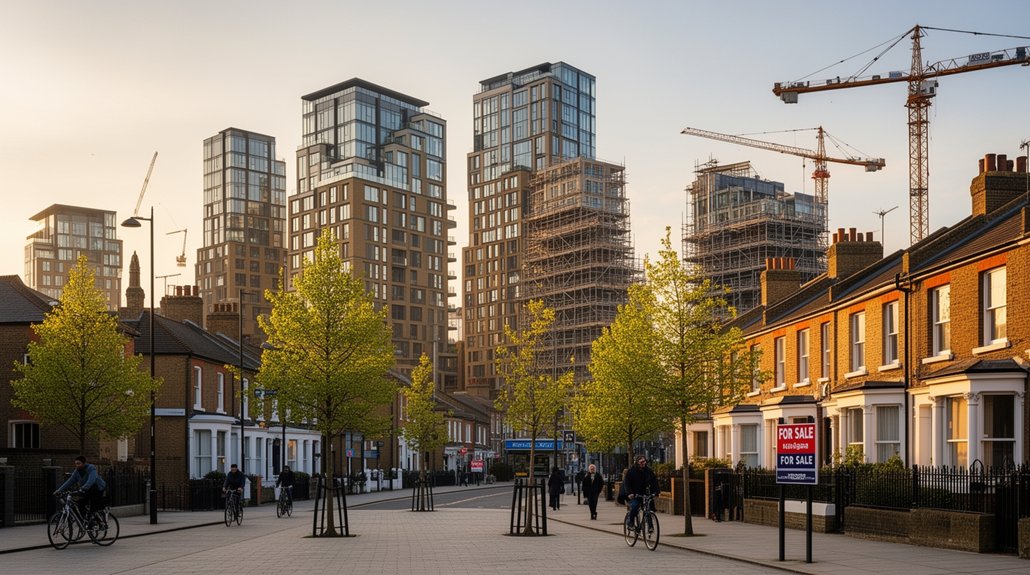
Chelmsford’s no longer a quiet alternative for Essex buyers. You’re seeing London-grade rail links, steady regeneration spend, and tighter supply push demand up across family streets, commuter hubs, and investor stock. You can track the uplift in neighbourhood price bands, time-on-market, and rental competition, then match it to schools, amenities, and EPC upgrades. The next step is knowing where the momentum’s real—and where it’s already priced in…
Key Takeaways
- Chelmsford pairs sub‑40‑minute rail links to London with faster planning approvals, sustaining strong commuter-led demand.
- Regeneration around the station and town centre is adding amenities and new homes, boosting buyer confidence and absorption.
- Family demand concentrates in Great Baddow, Galleywood, and Springfield due to schools, greenspace, and community infrastructure.
- Investor interest stays high near the station, ARU, and hospital, where tenant demand reduces voids and supports reliable yields.
- Price and rent growth are strongest in micro-markets with better EPC ratings, walkability, and commuter-time savings versus higher service-charge streets.
Why Chelmsford’s Property Market Is Booming

Although Essex has seen steady price momentum for years, Chelmsford’s market is booming because it combines London-grade connectivity with a faster planning pipeline and a broad base of demand.
You benefit from sub-40-minute rail links into Liverpool Street, plus strong local employment that supports resilient buyer depth. New Urban development around transport and town-centre regeneration keeps supply coming while lifting amenity value.
At the same time, Affordable housing delivery and shared-ownership stock widen the purchaser pool, reducing reliance on any single segment. You should track planning approvals, build-to-rent pipelines, and school-capacity metrics because they signal where absorption will stay high.
When you align your budget with energy efficiency and modern layouts, you’ll compete better and feel part of Chelmsford’s upward cycle.
Best Chelmsford Areas for Families, Commuters, Investors
When you map Chelmsford by commute times, school performance, and rental demand, clear micro-markets emerge for families, commuters, and investors.
If you’re family-first, look at Great Baddow, Galleywood, and Springfield: you’ll typically get stronger school catchments, larger greens, and reliable local amenities that keep daily routines smooth. You’ll also find active community events that help you plug in quickly.
If you’re commuting, aim for the city centre, Chelmsford station vicinity, and areas along the A12 corridor like Chelmer Village, where you can reduce door-to-train and road access friction.
If you’re investing, target high-turnover rental zones near the station, ARU, and the hospital, where tenant demand stays resilient and void periods trend lower.
Chelmsford House Prices by Neighbourhood (2024–2026)
To price Chelmsford accurately in 2024–2026, you’ll need to benchmark each neighbourhood’s median sold prices and £/sq ft so you can spot true price hotspots versus one-off outliers.
Track year-on-year change by postcode segment and property type, because growth rates won’t move in sync across the city.
Then you can target value areas to watch—where price gaps to comparables stay wide but transaction volume and days-on-market signal rising demand.
Neighbourhood Price Hotspots
Where are Chelmsford’s fastest-moving price hotspots heading into 2024–2026? You’ll see the strongest heat around the city centre and Chelmsford station catchment, where Urban redevelopment pipelines and walkable Local amenities keep demand liquid.
In Springfield and Chancellor Park, family-led buyers compete for newer stock, good schools, and predictable commute access.
Great Baddow and Galleywood sit in the “space-plus-connectivity” band, attracting upsizers who still want quick routes to retail and services.
For value-with-upside, look to Chelmer Village and Moulsham: solid owner-occupier demand, steady rental interest, and practical links to employment hubs.
To fit in fast, benchmark each pocket by average sold prices, days-on-market, and stock turnover, then align your offer terms to the street, not the postcode.
Yearly Price Change Trends
When you compare 2024 baselines to 2025–2026 runs, watch for three signals: acceleration (bigger YoY gains with tight supply), deceleration (gains narrowing as listings rise), and reversals (YoY turning negative after heavy reductions).
If you’re joining the Chelmsford market, align your offer strategy to the local trend, not the town-wide headline indices alone.
Value Areas To Watch
Although Chelmsford’s headline average keeps climbing, neighbourhood-level pricing between 2024 and 2026 shows you where value still exists—typically in areas with solid commuter links and improving amenities but less “prime” pricing baked in.
Look at Springfield and Great Baddow for steadier £/sq ft versus city-centre stock, while keeping access to rail, schools, and retail parks. In 2024–2026, you’ll often see better yield resilience in 2–3 bed terraces and semis here than in new-build apartments.
If you want upside, track Melbourne and Moulsham where historical development supports consistent demand, yet some streets lag the wider uplift. Cultural influences—cafés, community events, riverside walks—add “stayability” that tightens rental voids.
You’ll belong faster by buying near hubs and active local groups.
Chelmsford Rents in 2026: Costs and Competition
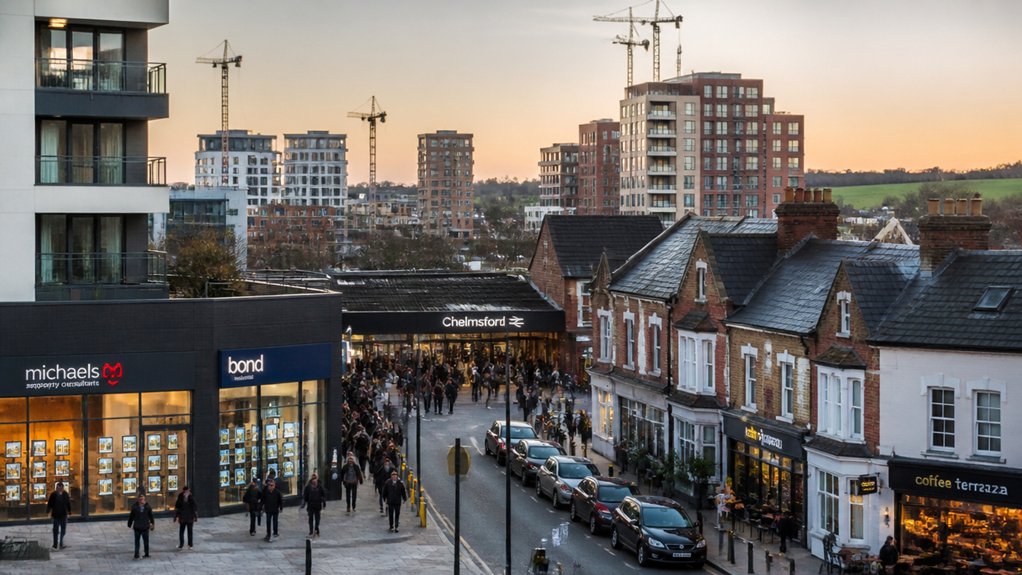
In 2026, you’re budgeting against higher average rents in Chelmsford, so you’ll need current asking-price data by property type before you commit.
You’re also competing in a tighter tenant market, where faster application turnaround and stronger affordability metrics can decide who secures a let.
You’ll see meaningful neighbourhood price gaps, so you should benchmark hotspots versus better-value areas to optimise cost, commute, and availability.
Average Rent Levels 2026
As 2026 rent negotiations tighten across Essex, you’ll see Chelmsford priced increasingly like a commuter-led growth market rather than a fringe alternative to London. Typical monthly asking rents sit around £1,250–£1,350 for a one-bed and £1,550–£1,750 for a two-bed, with newer stock and station-adjacent blocks pushing higher.
To protect rental affordability, you’ll need to benchmark by micro-location (city centre vs. Great Baddow/Springfield) and by EPC rating, since efficient homes often command a 3–6% premium.
Align your search with tenant preferences: fast broadband, secure parking or bike storage, and pet-friendly terms. If you want to feel part of the community, prioritise walkable neighbourhoods near schools, parks, and high-street services.
Rising Tenant Competition
Higher asking rents in Chelmsford don’t just lift your monthly budget—they compress your decision window, because tenant demand keeps outpacing available stock in 2026. You’ll see listings go under offer within days, and agents prioritise applicants who can move fast, prove affordability, and offer clean references.
To stay competitive, you should line up documents, set alerts, and be ready to view the same day.
If you’re already renting, your leverage is speed and reliability: Tenant retention matters to landlords facing re-letting costs and void periods.
Use Lease renewal strategies early—request a review 90 days out, propose a longer fixed term, and offer direct debit certainty.
You’ll fit in with the most valued renters: consistent, prepared, and low-friction.
Neighborhood Price Differences
While Chelmsford’s average rents keep rising in 2026, what you’ll actually pay hinges on the postcode: City Centre and Springfield typically sit at the top of the market for apartments and commuter-friendly stock.
Great Baddow and Galleywood often price in steadier value for families needing space, and areas farther from Chelmsford station tend to trade lower rents for longer travel times.
Track historical price disparities by comparing achieved rents, not asking prices, across two-bed flats and three-bed houses.
If you’re targeting walkability and a “local” feel, budget a premium for station adjacency and newer builds.
If you want more space and community amenities, prioritise schools, parks, and parking, then negotiate on longer leases.
For landlords, map neighbourhood investment potential to regeneration, EPC upgrades, and tenant churn rates.
Where Regeneration Is Boosting Chelmsford Demand
Because regeneration funding has targeted transport links, public environment upgrades, and mixed-use schemes, you can see demand clustering around Chelmsford’s most actively reshaped neighborhoods—especially near the rail station and the city-centre core.
Track footfall, letting velocity, and planning pipelines: where schemes complete, buyer enquiry typically lifts first for flats and small houses within a 10–15 minute walk.
Follow the Urban renewal map: upgraded public sphere, safer routes, and new retail frontages pull renters and owner-occupiers alike.
You’ll also notice Cultural districts strengthening evening economy and weekday spend, which supports steadier yields and lower vacancy risk.
Compare EPC profiles, service-charge trends, and commuter-time savings to spot streets benefiting most.
If you want to feel rooted, prioritise areas with schools, parks, and active community programming nearby.
Buy, Sell or Invest in Chelmsford: Next Moves
If you’re deciding whether to buy, sell, or invest in Chelmsford next, start by matching your move to the local drivers that show up in the numbers: rail-led commuter demand, regeneration-linked price pressure near the centre, and rental depth from professionals and young families.
If you’re buying, prioritise walkable stations and schools, and stress-test affordability against rates and service charges.
If you’re selling, time your listing around peak search periods and price to recent, postcode-level comparables to protect market sustainability and avoid stale days-on-market.
If you’re investing, target EPC-ready stock and realistic yields, then model voids, management, and refurb costs.
Don’t ignore property tax implications: stamp duty bands, capital gains timing, and allowable expenses.
Join local agents’ data briefings to stay aligned with the city’s momentum.
Conclusion
Chelmsford’s growth isn’t hype; it’s numbers plus momentum. You’ve got London-speed rail links, measurable regeneration uplift, and persistent buyer-and-tenant demand supporting pricing and rents. If you’re buying, prioritise school catchments, walk-to-station zones, and EPC A–C stock. If you’re selling, price to recent comparables and highlight transport and upgrades. If you’re investing, target yield-first neighbourhoods and low-void assets—track pipeline projects, track supply, track absorption.
About the Author