
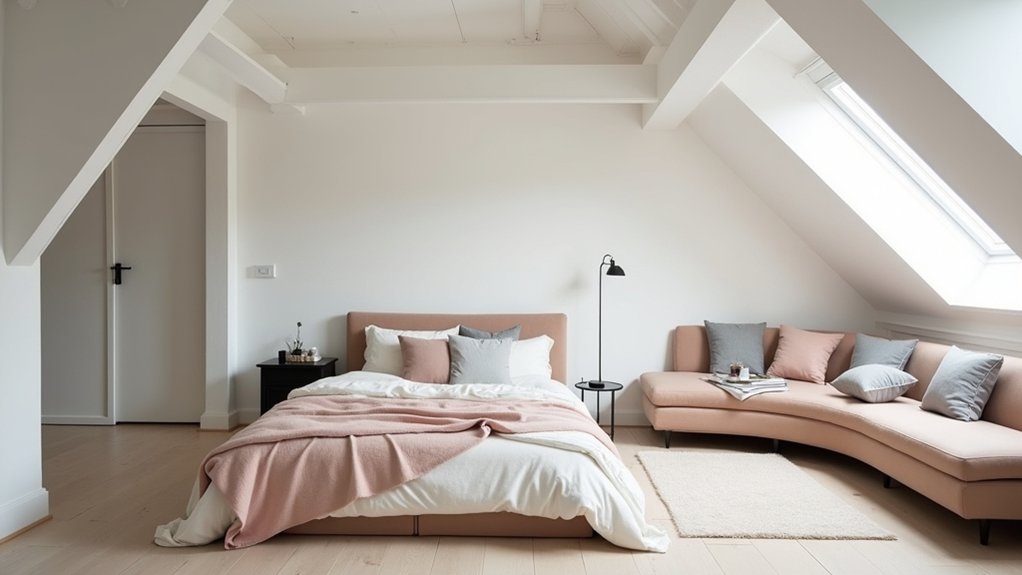
You probably don’t know that your loft’s perceived “softness” depends more on sheen level and light bounce than on color choice. Start by mapping daylight, ceiling height shifts, and circulation so you can zone sleep, storage, and dressing without visual clutter. Then build a muted palette around warm neutrals, low-glare finishes, and textures like linen or limewash that play nicely with brick and steel. Next, you’ll need to make the furniture and lighting do the heavy lifting…
Key Takeaways
- Map daylight, ceiling heights, and circulation first, placing the bed under 42+ inches of head clearance and routing paths along the tallest lines.
- Choose a muted neutral base (warm white, greige, putty) that matches fixed undertones, keeping contrast low-to-mid and repeating accents 2–3 times.
- Use matte or eggshell finishes and texture layering (linen, bouclé, limewash) to add depth while minimizing glare from windows and skylights.
- Select low-profile furniture with closed storage, maintaining 24–30 inches around the bed and 18–24 inches at nightstands for easy movement.
- Finish with tailored window treatments, dimmable warm LEDs (2700–3000K, CRI 90+), and integrated hidden storage to keep the loft serene and uncluttered.
Assess Loft Light, Ceiling Height, and Flow
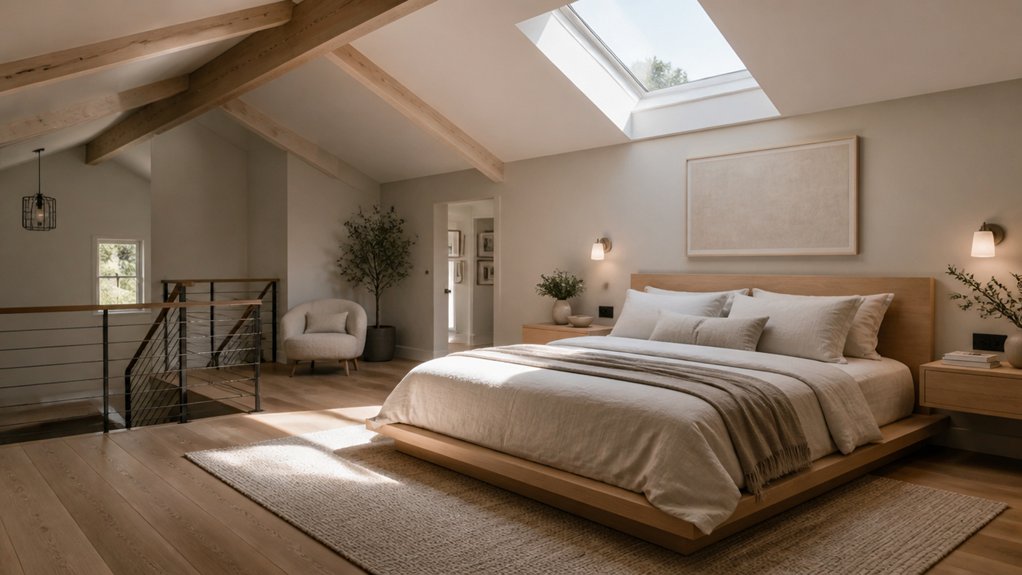
Before you pick finishes or furniture, map how your loft actually performs: track daylight direction and intensity across the day, note any shadow lines from beams or partial walls, and measure ceiling height where you’ll stand and where you’ll sleep.
Use that data to set zones: place the bed where head clearance exceeds 42 inches, and route circulation on the tallest line to avoid ducking.
Evaluate loft window placement for glare, privacy, and heat gain; a north-facing opening gives stable luminance, while west light needs shading.
Then plan airflow optimization: confirm cross-vent paths between operable windows, stairwell, and any ceiling fan sweep.
Keep 30 inches clear around egress points, and test door swings with tape layouts.
Start a Soft Modern Loft Bedroom Color Palette
Start your soft modern loft bedroom palette with a muted neutral base—warm white, greige, or putty—to stabilize open volume and diffuse mixed daylight.
Then layer warm accent hues like clay, camel, and terracotta in controlled doses through textiles, art, and one focal surface.
Keep contrast low-to-mid and repeat each accent 2–3 times so the scheme reads cohesive, not cluttered.
Choose Muted Neutral Base
Because loft bedrooms amplify light and shadow across open surfaces, you’ll get the most modern mileage from a muted neutral base—think warm greige, soft taupe, putty, or stone rather than stark white.
Start by matching undertones to fixed elements like concrete, brick, or oak; you’ll avoid color cast and keep Muted tones consistent from day to night. Specify a matte or eggshell finish to reduce glare on large walls.
Then build depth through subtle textures—slub linen, bouclé, limewash, or microcement. Keep contrast low but readable so the architecture stays crisp, not busy.
- Use one wall color across the volume to unify sightlines
- Choose textiles in adjacent neutrals for clean layering
- Repeat the same neutral in paint, rug, and bedding trims
Layer Warm Accent Hues
A muted neutral base gives your loft bedroom a clean, modern envelope; now bring it to life by layering warm accent hues that won’t fight the architecture. Start with low-chroma terracotta, camel, clay pink, or smoked saffron to complement concrete, brick, and black steel.
Layer warm accent hues in controlled ratios: keep 70–80% neutral, 15–25% warm midtones, and 5% deep anchors like oxblood or espresso. Use textiles first—linen duvet, wool throw, boucle chair—then echo the color in one hard element such as a ceramic lamp, framed art, or leather pull.
Repeat each accent at least twice to avoid visual noise. To create cozy focal points, concentrate warmth around the bed wall, reading nook, or rug zone, and keep ceilings cooler to preserve loft airiness.
Pick Warm Paint Colors and Low-Glare Sheens
You’ll get a modern, relaxed loft bedroom vibe faster by anchoring the walls in cozy neutrals like warm whites, greige, putty, or muted clay.
Test your paint’s sheen in daylight and at night under your actual fixtures, since loft windows and exposed bulbs can exaggerate glare. Stick with low-glare eggshell or matte finishes to soften bounce, hide surface flaws, and keep the palette looking current.
Choose Cozy Neutral Palettes
Even if your loft bedroom leans industrial, a cozy neutral palette can soften the hard edges without diluting the modern tone. Start with warm whites, greige, or clay-tinted beige; these hues counter concrete and metal while keeping the space crisp. Specify low-glare sheens like matte or eggshell to control reflection on tall walls and sloped ceilings, and to mask minor surface flaws typical in converted spaces.
Keep undertones consistent (yellow-red family or green-gray family) so trim, textiles, and built-ins read intentional.
- Pair warm neutrals with blackened steel accents for contrast
- Layer natural textures (linen, wool, oak) to prevent flatness
- Add Artistic wall decor and statement lighting to anchor focal zones
Test Sheen Under Light
Because loft bedrooms amplify glare with tall planes, skylights, and exposed metal, test warm paint colors and low-glare sheens in the exact lighting you live with before you commit. Paint 2-foot squares on multiple walls, including one near the window and one in shadow.
Run Sheen testing by comparing the same color in eggshell versus satin, then view it at morning, midday, and night with your actual bulbs.
Track Light reflection by standing at the bed, doorway, and closet line; look for hot spots on angled ceilings and any haloing around fixtures.
If the color shifts too pink or too yellow, pivot toward balanced warm neutrals like greige or clay-beige.
Photograph samples with exposure locked so you judge change, not camera auto-correction.
Favor Low-Glare Finishes
If your loft bedroom mixes skylight spill, exposed steel, and long ceiling runs, prioritize low-glare finishes that keep warm paint colors looking controlled instead of shiny. Choose modern warm neutrals—clay, oat, mushroom, muted terracotta—then dial sheen down to reduce specular hotspots on big planes.
In most lofts, matte on ceilings calms bounce, while eggshell on walls survives cleaning without flashing. Reserve satin only for trim where you want crisp edges around Vintage accents.
- Matte ceilings to mute skylight glare and hide roller overlap
- Eggshell walls for balanced wash, ideal behind Artistic murals
- Low-luster trim to frame steel, doors, and built-ins without mirror shine
Pair with diffused lamps and avoid high-gloss lacquer near windows to keep tones soft, consistent, and contemporary.
Match Finishes to Brick, Beams, and Metal Details
When you treat brick, exposed beams, and metalwork as fixed “materials of record,” you can specify finishes that look intentional rather than patched together. Start by sampling undertones: warm brick leans terracotta, cool brick skews violet-gray; aged timber reads honey or espresso; steel reads blue-black.
Then tune your paint and textiles to those reads, not to a showroom swatch.
For brick, choose mineral or limewash-inspired paints nearby in value to preserve industrial textures without glare.
For beams, match stain saturation to the room’s soft neutrals so grain stays legible.
For metal, repeat one temperature—blackened steel, brushed nickel, or aged brass—and keep sheen consistent.
This restraint creates architectural harmony while letting modern tones feel calm and cohesive throughout.
Choose Clean-Line Loft Bedroom Furniture (Right Scale)
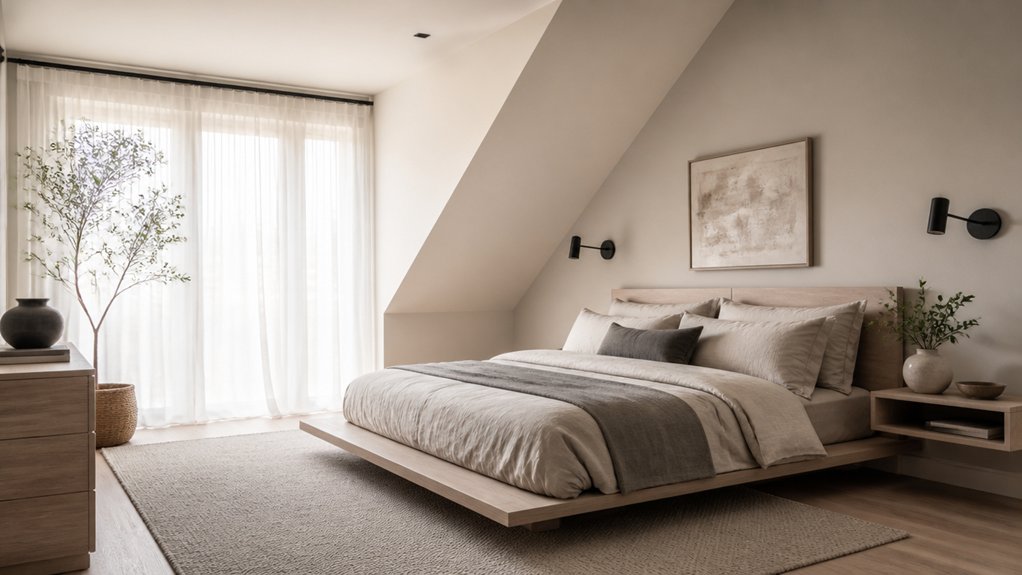
Even though loft bedrooms can handle bold pieces, clean-line furniture in the right scale keeps the space modern instead of visually noisy. Start by measuring your circulation paths; you’ll want 24–30 inches of clearance around the bed and 18–24 inches at nightstands.
Pick low-profile silhouettes and thin planes that echo industrial aesthetics without competing with beams or brick. Favor closed storage to reduce visual chatter and support minimalist design, especially in open-plan lofts.
Scale matters: a king on spindly legs reads unstable, while an oversized dresser can dominate the volume.
- Choose a platform bed with a slim headboard and recessed base
- Use wall-mounted or narrow nightstands to preserve floor area
- Select a tall, shallow wardrobe to leverage vertical height
Layer Cozy Textiles Without Overcrowding
Although loft bedrooms thrive on restraint, you can still build warmth by layering textiles with a tight edit—think fewer pieces, higher impact.
Start with a low-profile rug in a flatweave or tight boucle to anchor the bed zone without swallowing floor space. Add one mid-weight duvet in a muted modern tone, then top it with a single throw for contrast.
Mix textile textures deliberately: matte cotton percale, brushed wool, and a small hit of velvet or slub linen keep the palette soft but dimensional.
For decorative layering, limit pillows to two sleep pillows plus two shams; skip extra cushions unless they earn function.
Choose tailored curtain panels or a roman shade in a solid, and keep hems crisp. Stay consistent across materials.
Plan Gentle Loft Bedroom Lighting (Ambient to Task)
Keep that tightly edited textile stack feeling calm by pairing it with a lighting plan that layers from soft ambient to precise task.
Start with Natural light: assess Window placement and sightlines, then use sheer rollers to diffuse glare while preserving daytime warmth.
For evenings, aim for 2700–3000K LEDs, high CRI (90+), and dimmable drivers so tones stay true.
Anchor the loft with indirect ambient, then add targeted beams where you read, dress, or work without flooding the whole volume.
Control spill and shadows with shields, swivels, and wall-wash angles that flatter plaster and paint.
- Use a dimmable cove or uplight for low-glare ambient.
- Install adjustable sconces at the bed for reading.
- Add a focused desk or vanity lamp with cutoff optics.
Hide Loft Bedroom Storage in Plain Sight
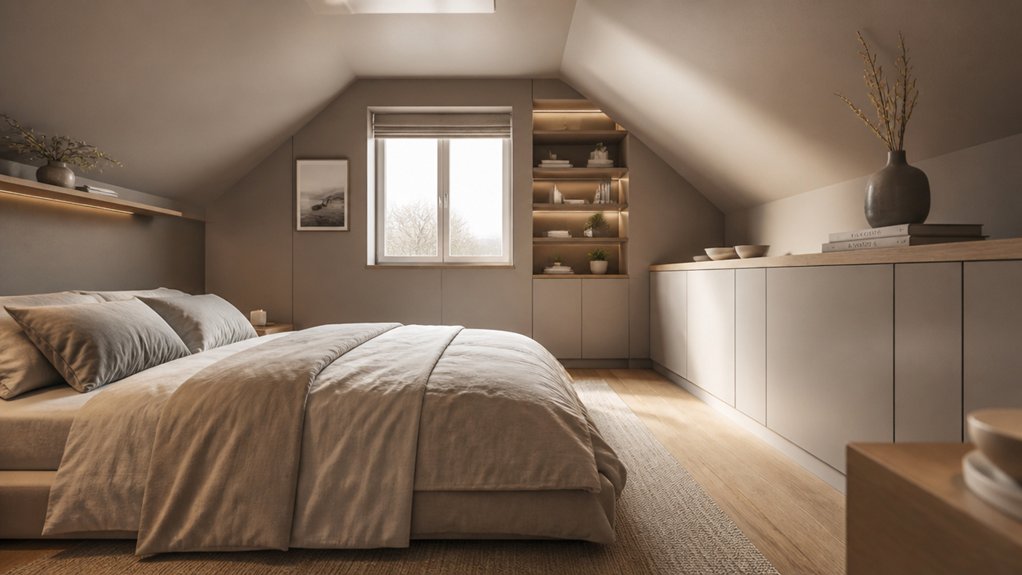
When your loft bedroom has to do double duty, you can make storage disappear by building it into the architecture and matching finishes so the eye reads one clean plane. Run floor-to-ceiling cabinets along the knee wall, then use push-latch, handleless fronts in the same paint sheen as adjacent drywall to cut visual clutter.
Tuck drawers into the stair risers or platform bed base, and spec full-extension slides so access stays ergonomic.
For closets, add pocket doors or curtain panels in a soft, modern textile; keep hardware matte and low-contrast. Use mirrored or fluted glass on a single bay to bounce light without revealing contents.
Inside, install vertical dividers and labeled bins so Hidden storage actually stays orderly, and you won’t reintroduce mess.
Conclusion
You’ve now shaped your loft bedroom like a calm operating system: light and flow dictate the layout, a muted palette and warm low-sheen paint reduce glare, and finishes echo brick, beams, and metal. You keep furniture low-profile, then add textiles in controlled layers for softness without clutter. You build lighting from ambient to task for flexibility, and you tuck storage into millwork and under-bed volumes. The result feels modern, quiet, and effortlessly functional.
About the Author