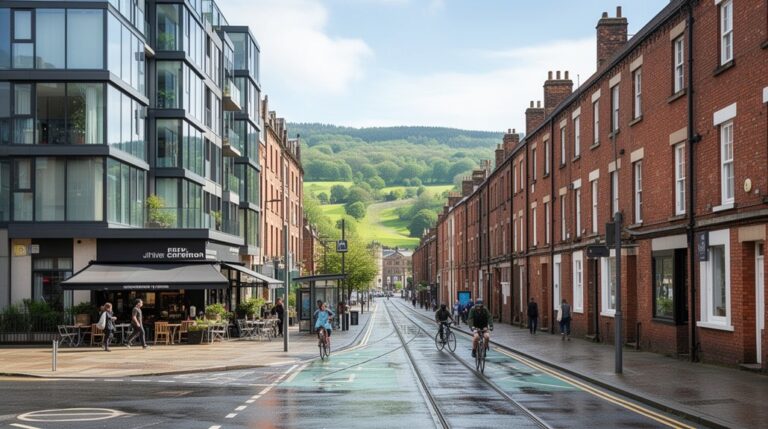
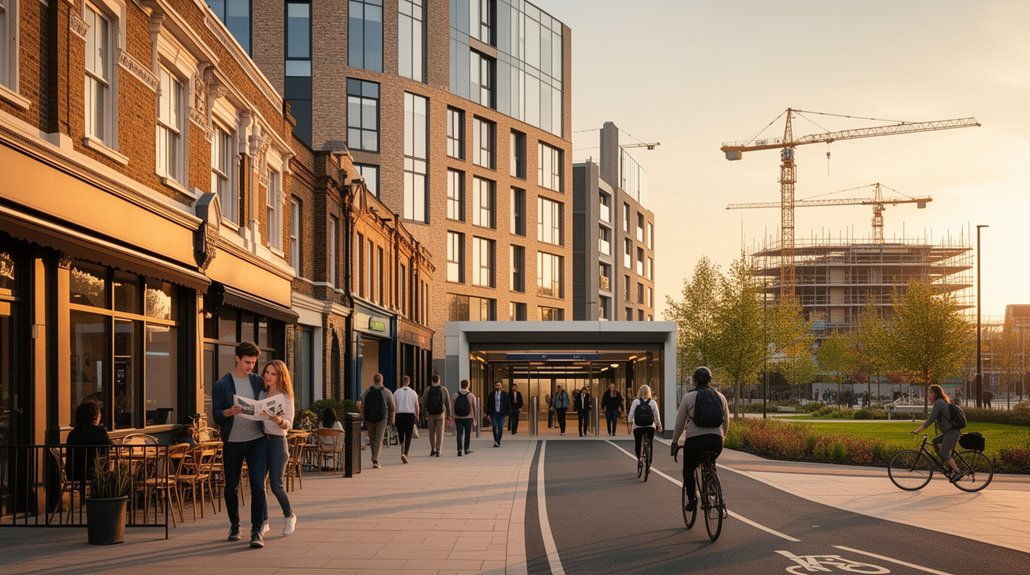
If you’re weighing Slough in 2026, you can’t ignore how regeneration is shifting buyer demand and price resilience. You’ll see completed public-realm upgrades, higher-density schemes near stations, and more refurbishment opportunities in older stock that still pencils out. Faster Elizabeth line links and road improvements cut commute risk, while town-centre amenities and walkability change how you value specific streets. The key question is which pockets are finished, which are promised, and what that means for your budget.
Key Takeaways
- Slough’s town-centre public realm upgrades and mixed-use regeneration are improving walkability, amenities, and buyer confidence in the core corridor.
- Elizabeth line and improved rail services cut commute times to London and Heathrow, making Slough more attractive to professionals and families.
- High-density apartments and build-to-rent schemes near stations expand choice, especially for first-time buyers and renters seeking modern homes.
- Value-add refurb opportunities in Victorian and interwar terraces let buyers improve EPC ratings, layouts, and resale value at a lower entry price.
- Demand concentrates near strong school catchments, parks, and safer evening routes, so ward-level crime data and school performance shape micro-location appeal.
Slough Regeneration in 2026: What’s Finished Vs Planned
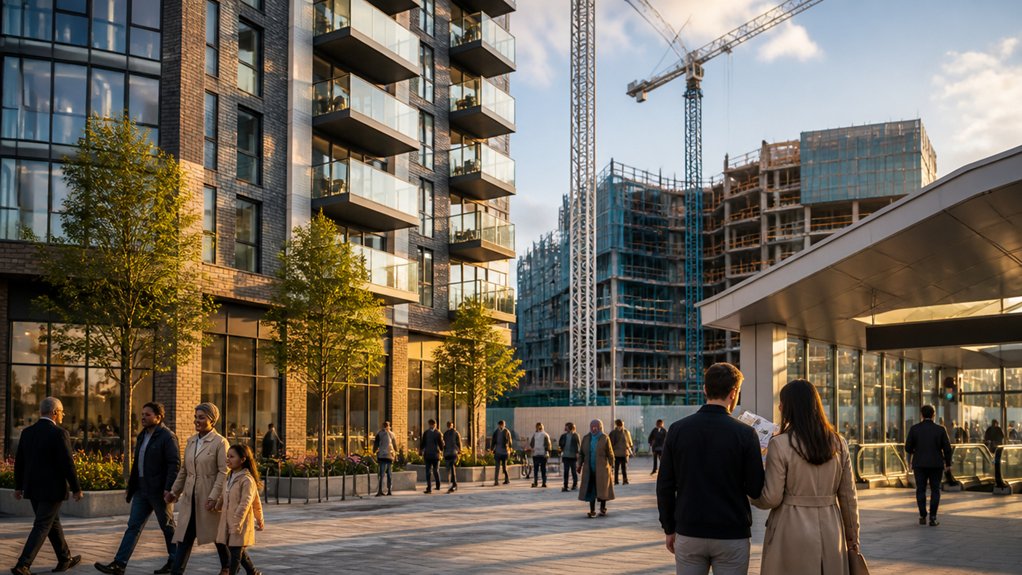
Although Slough’s regeneration programme has been running for years, 2026 is the point where you can clearly separate what’s already delivered (and therefore priced into today’s stock) from what’s still pipeline (and carries delivery risk).
You’ll see completed public-realm upgrades around the centre, steadier footfall, and tighter letting voids—signals that refurbs near finished amenities command less discount.
You can underwrite value-add by targeting homes that need kitchens, roofs, or EPC lifts within walking distance of established Urban green spaces, because buyers pay for everyday liveability.
For pipeline schemes, you should price in delays and favour properties where you can force appreciation through extensions, reconfigurations, and insulation now.
Track planning updates tied to Local business development; new operators anchor demand and help you feel part of a growing neighbourhood.
How Has Slough’s Transport Improved for Commuters?
You’re getting faster, more reliable access to London and the Thames Valley thanks to Slough’s Elizabeth line connectivity, which widens your commuting radius and strengthens resale demand.
You’ll also notice upgraded rail capacity and smarter road links cutting journey friction, a practical win if you’re pricing renovations around buyer commute-time sensitivity.
If you’re refurbishing to sell or let, these transport gains help you justify higher specs and tighter yield expectations.
Elizabeth Line Connectivity
Since the Elizabeth line started calling at Slough, your commute calculus has shifted: you now get faster, more frequent rail links into central London while keeping direct access to Heathrow via nearby connections, which widens the buyer pool and strengthens resale demand for well-finished homes.
You can price renovation choices with commuter logic: add acoustic glazing, smart heating, and durable finishes that suit early starts and late returns.
With step-free stations and turn-up-and-go frequency, you’re less reliant on timetables, so a smaller home office can still feel workable. That flexibility shows up in viewings: buyers compare door-to-desk time, not just square footage.
If you restore Historical architecture details while supporting Community engagement near the station, you’ll signal pride-of-place and help your property feel “in” rather than merely adjacent.
Upgraded Rail And Roads
Elizabeth line frequency sets the baseline, but Slough’s broader transport upgrades—mainline rail performance and road capacity—now shape how buyers judge daily reliability and running costs.
You’ll feel it in faster, more predictable Great Western services, with modernised timetables and station improvements that cut platform pinch points and reduce missed connections.
On the road, targeted junction works around the M4 and A4 corridors smooth peak-hour flow, lowering fuel burn and making tradespeople visits easier when you’re renovating.
That access lifts resale confidence: surveyors and agents price in commute certainty and fewer transport frictions.
Better links also widen your social radius—so you can restore Historic architecture near the centre and still get to local community events without a scheduling gamble.
Which Slough Areas Benefit Most From Regeneration?
While regeneration spend tends to ripple out from the town centre, Slough’s biggest upside concentrates in the core corridor around the station and high street—where transport-led upgrades, public-realm works, and higher-density residential schemes tighten rental demand and shorten resale timelines.
This then extends into walkable fringe neighbourhoods like Chalvey, Farnham Road, and Langley, where older housing stock and mixed-use infill create the clearest “buy, refurb, and revalue” opportunities.
If you target Victorian and interwar terraces in Chalvey and Farnham Road, you can add value fast through insulation, layout tweaks, and compliant loft conversions, then capture uplift as footfall improves.
In Langley, you’ll benefit from steadier owner-occupier demand and schools, so finishes and kerb appeal matter.
You’ll also see momentum where Historical preservation protects character while Local business development boosts amenity density and neighbour pride.
What New Housing Is Being Built in Slough: and Where?
You’ll see Slough’s new supply clustering in three high-demand corridors: major town-centre schemes that stack apartments near jobs and retail, canal and waterside builds that price in lifestyle premiums, and rail-linked housing zones that leverage fast commutes.
Track unit mix, delivery timelines, and price-per-sq-ft against resale comparables so you can spot where value’s being created rather than just marketed.
If you’re renovation-minded, target nearby older stock in these catchments, where public-realm upgrades and new amenities can lift rents and exit prices fastest.
Major Town Centre Schemes
Because demand near Crossrail-adjacent hubs keeps pricing power concentrated in walkable cores, Slough’s town-centre regeneration pipeline targets higher-density apartment-led schemes around the station, the high street, and key junction sites—bringing new-build homes to places where you can quantify uplift through shorter commute times, improved public environment, and the re-rating of tired retail plots into mixed-use blocks.
You’ll see phased towers and mid-rise blocks replacing underperforming retail, with ground-floor units designed to keep footfall steady and service charges defensible.
Track schemes around the station quarter and high-street nodes where planning policy favours car-lite living, urban sustainability, and cultural revitalization through new public sphere and flexible community space.
If you’re renovation-minded, focus on adjacent Victorian streets: uplift often spreads one to two blocks out as investors upgrade stock to match new comparables.
Canal And Waterside Builds
If you’re hunting value away from the station premium, Slough’s canal-edge and waterside pipeline gives you a more measurable “amenity uplift” story—new homes cluster along the Grand Union Canal corridor and around key crossings where developers can price in towpath upgrades, new bridges, and mixed-use frontages.
You’ll see mid-rise apartments and compact townhouse rows near the canal, with ground-floor commercial or resident hubs that convert footfall into safer, livelier edges.
Track schemes where public-realm spend is ring-fenced: lighting, seating, cycle links, and biodiversity buffers tend to support resale and rent resilience.
For renovators, look for early-phase blocks with snagging headroom and lease terms you can negotiate.
Canal aesthetics sell, but Waterside amenities—cafés, play space, moorings—keep communities sticky.
Rail-Linked Housing Zones
Canal-side uplift is one angle, but Slough’s biggest price lever still sits on the rail spine—zones within a short walk of Slough station and the Elizabeth line stops at Langley and Burnham keep absorbing the bulk of higher-density delivery. You’ll see mid-rise blocks, build-to-rent towers, and infill schemes replacing low-yield yards and tired parades, targeting commuters who’ll trade car space for frequency.
If you’re buying, prioritise units with strong EPC ratings and service-charge transparency; then add value by refitting kitchens, upgrading ventilation, and soundproofing for rail-adjacent living. Balance new-build convenience with nearby Historical architecture pockets—renovated terraces and shopfronts still anchor identity.
Plug into Local cultural events around the station quarter, and you’ll feel rooted, not just well-connected.
Slough Schools: Where Families Should Focus
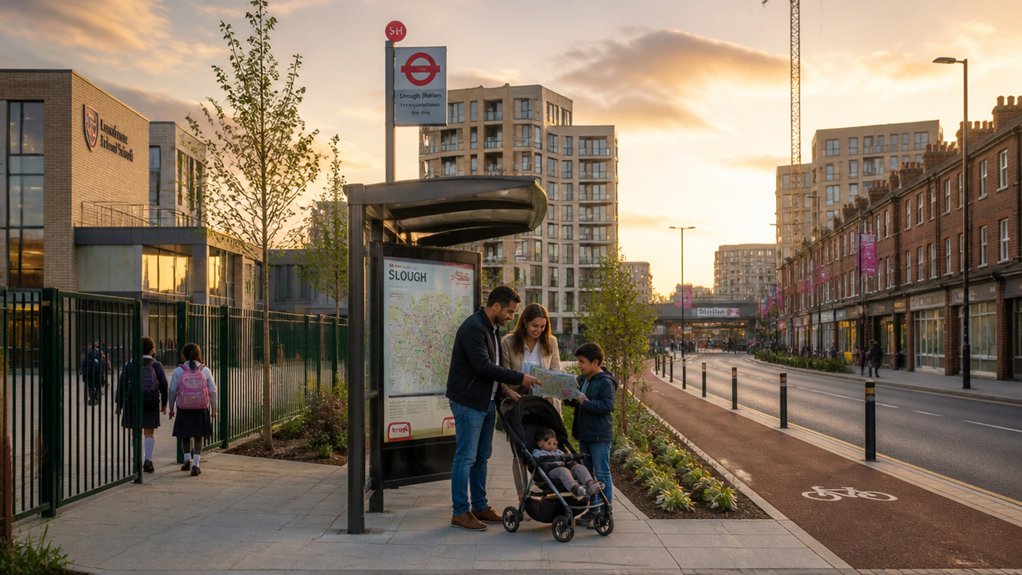
While Slough’s regeneration drives demand around the station and new-build corridors, school catchments still set the price ceiling for many family buyers, so you’ll want to map education performance before you shortlist streets. Start with Ofsted grades, Progress 8, and attendance, then overlay them with walking routes and admission criteria—micro-boundaries can shift values block by block.
Prioritise areas where primaries feed reliably into strong secondaries, because that “through-school” security supports resale and lets you plan renovations with a longer horizon.
When you view homes, check Local education links to clubs, SEN support, and language provision, plus nearby community facilities like libraries, sports halls, and youth groups. You’ll feel the difference on weekday mornings and at pickup chats.
Slough Town Centre: Amenities, Public Spaces, Safety
Because town-centre walkability now drives a measurable share of Slough’s buyer demand, you’ll want to assess amenities, public space quality, and safety with the same rigour you apply to floorplans and EPC ratings. Map your daily needs: station access, GP, gyms, and Local shopping that stays active beyond office hours, because footfall supports resale.
Check how Public parks and plazas connect to residential streets; well-lit routes and maintained landscaping typically signal stronger stewardship and lower anti-social behaviour risk. Validate it: read ward-level crime dashboards, track reported incidents by time of day, and visit after dark.
For renovation value, prioritise homes near upgraded pavements and new mixed-use blocks—these tend to attract cafes, services, and neighbours who’ll actually use shared space.
Slough House Prices vs Windsor, Maidenhead, Reading
If you’re benchmarking Slough against Windsor, Maidenhead, and Reading, start with the price-per-square-foot gap: Slough typically trades at a discount, so your renovation budget buys more internal space and more upside once you lift finish quality to commuter-market expectations.
Windsor’s premium reflects Historical architecture and tight supply; you’ll pay for charm before you touch a kitchen. Maidenhead prices in Crossrail-era demand, so value-add often means extensions, not refits.
Reading’s market sits between, with stronger rental comps near the station, but competition compresses yields. In Slough, focus on EPC upgrades, sound insulation, and durable mid-market finishes; you’ll meet buyer expectations without over-spec’ing.
Track sold-price spreads on similar terraces, then target streets backed by Local community initiatives so you’ll feel rooted, not just invested.
Conclusion
You’re looking at Slough as a regeneration-led buy: new public spaces, higher-density housing by stations, and faster links that keep demand resilient. With the Elizabeth line, you can reach Paddington in about 17 minutes, shrinking the “commuter penalty” and supporting resale. If you’re market-savvy, target walkable hubs and renovation-ready stock—value lifts fastest where amenities and transport stack up. Buy with a refurbishment plan, and you’ll ride both yield and growth.
About the Author