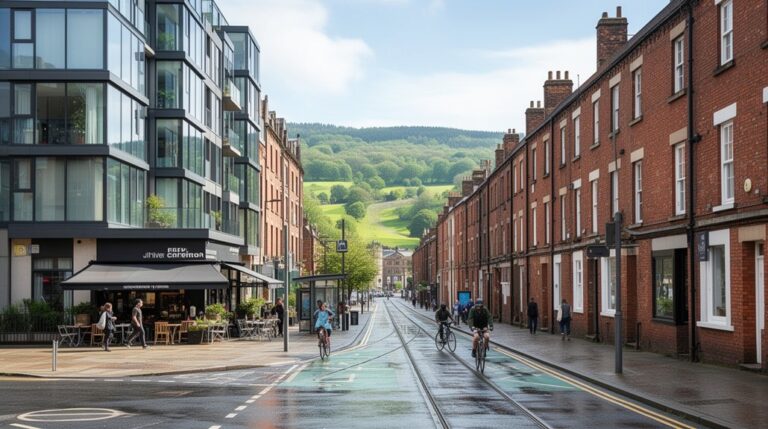

You’re paying a clear premium in Guildford in 2026, and it only holds if tight land supply, top-school demand, and fast London links keep outpacing nearby alternatives like Woking, Farnham, and Godalming. Regeneration and amenities still support pricing, but rising comparable supply, shifting WFH patterns, and rate-sensitive affordability can soften margins quickly. The key question isn’t whether values fall—it’s where the premium breaks first, and why.
Key Takeaways
- Verify Guildford’s premium using recent sold £/sq ft, days-on-market, and sale-to-list ratios versus nearby Surrey like-for-like homes.
- Premium resilience depends on durable location utility: walkable rail links, strong schools, and retail access sustaining consistent bidding.
- Limited supply from green belt and strict planning constrains new stock, supporting higher prices and reducing discounting.
- Track school catchment rules and boundary reviews, since small admissions changes can create price cliffs and shift demand quickly.
- Monitor regeneration, amenity upgrades, and buyer mix stability, because diversified demand from commuters and downsizers helps defend pricing in downturns.
Is Guildford Still Worth the Premium in 2026?

Although Guildford’s price tag still sits above much of Surrey in 2026, the premium can make sense if you’re buying for resilient demand drivers rather than short-term appreciation: a London-commutable rail offering, consistently strong school catchments, and a constrained stock profile that keeps higher-quality homes scarce.
You’ll judge “worth it” by livability and liquidity. Track days-on-market for family houses near key schools, and compare achieved prices versus asking to see where buyers still compete. Prioritise walkable access to stations, High Street, and green space; those micro-locations typically hold demand when rates bite.
You also buy into Luxury amenities—independent gyms, dining, and upgraded period renovations—without losing historical charm. If you plan a five-to-ten-year hold, you’re more likely to feel part of a stable, aspirational community.
What “Premium” Means in Guildford Pricing
When you call Guildford “premium,” you’re talking about the price gap you pay versus nearby comparables for the same bed/bath count, lot size, and build quality.
You can quantify it by tracking sold-price-per-sq-ft, days on market, and discount-to-ask against Fraser Valley benchmarks.
That premium holds when demand concentrates around top school catchments, fast Vancouver access, low effective inventory, and newer or renovated product that reduces buyer risk.
Defining Guildford Premium Pricing
How do you know a Guildford property is priced at a true premium rather than just “expensive”? You benchmark it. Compare the home’s price-per-square-foot to the immediate micro-neighbourhood median, then adjust for lot size, condition, and recent renovated-vs-original comps within the last 90–180 days.
A true premium shows up as a consistent spread—often 10–25%—that still aligns with verified sales, not just list prices.
You also check what the market actually rewards. Premium in Guildford typically means measurable upgrades buyers in your community compete for: Luxury amenities (high-end kitchens, efficient systems, private outdoor living) plus historical significance that’s documented, preserved, and reflected in past transactions.
If those elements don’t move the comp range, it isn’t premium. It’s simply overpriced.
Drivers Of Premium Value
Benchmarks tell you whether a price premium is real; the next step is identifying what actually creates that spread in Guildford. You’ll usually see it in tighter days-on-market, higher sale-to-list ratios, and fewer price reductions for comparable homes within walkable, amenity-rich pockets.
You can trace the drivers to three levers. First, location utility: proximity to rapid transit, strong school catchments, and daily retail compresses buyer search radius and lifts bids.
Second, product differentiation: Luxury amenities—concierge security, fitness rooms, EV charging, high-end finishes—reduce friction and signal status you can share.
Third, Cultural influences: established dining, community events, and diverse services create belonging, keeping demand resilient even as rates move.
Track these variables per micro-market, not by postal code.
Guildford vs Woking, Farnham, Godalming: Prices
Although Guildford typically commands Surrey’s headline prices, you’ll get a clearer read on its staying power by comparing it directly with Woking, Farnham, and Godalming across like‑for‑like stock and recent sold data rather than asking agents for “guide” figures.
Start by matching 3–4 bed period semis, modern townhouses, and flats within 10 minutes of the station, then benchmark £/sq ft and median sold price over the last 6–12 months.
You’ll often see Guildford hold a premium over Woking on comparable commutability, and edge Farnham and Godalming when you price in Luxury amenities plus walkable retail, schools, and rail.
Yet Godalming’s tighter stock can compress the gap, while Farnham’s historical charm supports resilient family‑home pricing in key streets.
Who’s Buying in Guildford (and Why It Matters)
Where’s Guildford’s demand really coming from—and why should you care if you’re pricing a sale or weighing a purchase? Because buyer mix sets your ceiling. You’re not just selling bricks; you’re matching a lifestyle to budgets that stay resilient when rates or sentiment wobble.
You’ll see three core groups. First, London hybrid commuters who’ll pay for rail access plus Luxury amenities like gyms, concierge blocks, and turnkey finishes. Second, equity-rich downsizers seeking walkable centres, low-maintenance homes, and a community that feels established. Third, education-led buyers—families and academics—anchoring demand around schools and the university.
Cultural attractions matter across all three: theatres, festivals, and riverside dining help justify the premium. Track who’s viewing, their proceedability, and their must-haves, then price and present accordingly.
Why Guildford Supply Stays Tight (Green Belt + Planning)

Because you can’t easily build your way out of demand in Guildford, stock stays structurally tight—and that scarcity underpins pricing. You’re operating in a market ring‑fenced by Green belt restrictions, so land release is limited and infill opportunities face scrutiny.
That keeps new‑build volumes modest relative to commuter-led demand, which reduces down‑cycle oversupply risk.
You also see the impact of Planning policies: longer lead times, higher section obligations, and tighter design and density controls. Fewer permissions translate into fewer comparable new homes hitting the market at once, supporting price discovery for existing stock.
Practically, you’ll notice quicker absorption when well‑located homes launch, and fewer “must‑sell” discounts. If you want to feel part of Guildford’s established neighbourhoods, this constrained pipeline helps preserve the premium others compete to join.
How Guildford School Catchments Shape Sale Prices
You can often trace Guildford’s price gaps to school catchment boundaries, where being inside a sought-after line can add a measurable premium versus a similar home just outside it.
When Ofsted ratings move, buyer demand shifts quickly, and sale prices tend to reprice to reflect perceived school quality.
You’ll also see admissions policies (distance cut-offs, sibling priority, faith criteria) concentrate competition into specific streets, tightening demand and supporting higher achieved prices.
Catchment Boundaries And Premiums
Although two homes on the same street can look identical on paper, Guildford’s school catchment boundaries often create a measurable price gap, with buyers routinely paying a premium for addresses tied to higher-performing schools and more predictable admissions.
You’ll see this in achieved prices and time-to-offer: boundary-side homes attract more viewings, tighter bidding, and fewer concessions. Historical market trends show these micro-premiums hold even when wider Surrey demand cools, because families anchor their search to admission certainty, not just square footage.
To act practically, map the exact line, check past intake patterns, and budget for a “right side of the road” uplift. You’re also buying into community routines—walkable Local amenities, school-run networks, and peers—so you feel you belong.
Ofsted Ratings Price Impact
Catchment lines set the playing field, but Ofsted ratings often determine the size of the premium within it. In Guildford, “Outstanding” schools can add a measurable uplift versus “Good” peers nearby, because buyers price in consistency, not just proximity.
When you tour, compare sold prices on the same street across rating changes; you’ll often see tighter days-on-market and stronger bidding where inspection outcomes lead.
To act practically, track rating history and reinspection timing alongside commute links and Local amenities. If you want belonging without overpaying, target pockets where the school’s reputation is rising but the premium hasn’t fully priced in.
That’s where Market diversification helps: you’re not relying on one driver. You’ll still get community feel, while keeping resale resilience if sentiment shifts later.
Admissions Policies And Demand
When admissions rules tighten or priority zones shift, demand concentrates fast and sale prices move with it. If you’re buying in Guildford, you’ll see the sharpest premiums where walkable catchments align with top-performing schools and low supply; buyers bid aggressively to secure certainty.
Track published PAN numbers, sibling criteria, and distance cut-offs, then map recent completions within 0.25–0.5 miles of priority boundaries to spot price cliffs.
You can protect value by prioritising streets that sit safely inside the line, not on it, and by checking consultation timetables for boundary reviews.
Homes that pair school access with Luxury amenities and nearby green spaces tend to hold liquidity: they appeal to families who want community fit, not just square footage.
Commuting vs WFH: What Guildford Buyers Pay For
If you’re pricing a home in Guildford, you can’t ignore how the commute-to-London proposition stacks up against buyers who work from home. You’re selling into two demand pools with different value triggers: time-to-station and train frequency for weekday commuters, versus space, broadband reliability, and acoustic privacy for remote work.
Track viewing feedback: if buyers ask about walk time to London Road or Guildford stations, you can hold a sharper premium on “no-car” locations. If they ask about an office, garden studio potential, or 5G/fibre, you’ll win more by presenting flexible layouts than by leaning on commute claims.
Watch commuting habits: 2–3 days in town still rewards parking, drop-off routes, and a calm morning run-in. Position it as a neighbourhood fit, not just a postcode.
Town Centre Regeneration: What Lifts Guildford Values

Although headlines tend to overstate “regeneration,” Guildford values only reprice upward when specific town-centre upgrades measurably improve footfall, retail mix, and journey times. You’ll see it in transactional evidence: tighter vendor discounts near revived streets, faster time-to-offer, and fewer price cuts on comparable stock.
Track Historical market trends around prior public-realm works and transport tweaks; the uplift concentrates where shoppers linger and weekday activity looks less seasonal.
If you want to buy into lasting value, prioritise schemes that change behaviour: safer evening routes, higher-frequency bus links to the station, and curated independents that complement the High Street.
Local economic influences matter too—office occupancy, university growth, and hotel demand keep spend local, which supports resilient rents and steadier sale prices.
Mortgage Rates: How Stretched Is Guildford Affordability?
Because mortgage pricing now does most of the heavy lifting in monthly costs, Guildford’s affordability hinges less on list price and more on the gap between current rates and buyers’ income growth.
If your rate is 5–6%, a £600k loan can mean £3.5k–£3.9k monthly on a repayment basis, so small rate moves change eligibility fast. You’ll feel stress when lenders test affordability at higher “stress rates,” tightening how much you can borrow even with solid deposits.
To stay in the Guildford fold, you’ll need sharper budgeting: fix terms, reduce debt, and plan for product fees. Buyers still pay up for Luxury amenities and cultural attractions, but you’ll win value by negotiating on incentives and timing your mortgage offer.
Where Guildford Prices Are Most Likely to Soften Next
If you’re looking for where Guildford prices may soften next, watch segments where supply is rising faster than demand and affordability is thinnest.
You’ll likely see the most pressure on outer-edge family estates, new-build supply hotspots where completions stack up, and high-price detached homes that rely on top-end borrowing capacity.
You can track it by monitoring listing growth, time-on-market, and the size of price reductions in these pockets.
Outer-Edge Family Estates
While central Guildford stock still commands a scarcity premium, the outer-edge family estates—larger-lot pockets nearer the suburb boundaries—show the clearest setup for price softening. You’ll typically see longer days on market here and wider discounting when vendors chase last year’s peak.
Buyers compare these homes against nearby suburbs with similar block sizes, so the “Guildford badge” carries less pricing power at the fringe.
If you’re buying, prioritise streets with walkable Community amenities—parks, schools, local shops—and genuine Luxury amenities that hold up in valuations: quality renovations, efficient floorplans, and energy upgrades.
Avoid homes that rely on sheer land size without livability. When you negotiate, anchor on recent settled sales, not hopeful list prices, and you’ll still feel part of the Guildford story without overpaying.
New-Build Supply Hotspots
Outer-edge estates soften when the “Guildford badge” stops adding a premium; new-build supply hotspots soften when extra stock hits the market faster than demand can absorb it.
Watch areas with multiple phases launching within 6–18 months, especially near the A3 corridor and town-edge regeneration sites, where incentives reset comparable prices.
Track listing volume, price reductions, and time-on-market for similar-unit blocks; when reductions cluster, you’ll see the next benchmark form.
If you’re buying, protect Market stability by negotiating on specification, not headline price: parking, lease terms, and service charges move your true yield.
Choose developments where Luxury amenities serve daily life—walkable shops, childcare, gyms—not just marketing, so neighbours stay, resales tighten, and belonging feels real.
High-Price Detached Homes
Because demand thins fastest at the very top of the market, Guildford’s £1.5m–£3m detached homes are the most exposed to the next leg of price softening: the buyer pool is smaller, mortgage affordability bites harder, and even modest changes in achieved prices quickly reset comparables on these low-volume streets.
If you’re selling, watch time-on-market and price reductions: once listings sit past 8–12 weeks, you’ll typically need a 3%–7% reset to re-engage proceedable buyers.
You’ll also feel more negotiation around Luxury amenities; pools, cinemas, and annexes rarely add pound-for-pound value in tighter markets.
Homes with historical charm still win viewings, but you must price to the last completed sale, not yesterday’s ask.
Aim for “best house on the street,” not “outlier.”
Conclusion
You’re paying “the Guildford premium” for scarcity that’s meant to feel ordinary: Green Belt limits, tight planning, and school-led demand keep supply constrained even as nearby Woking, Farnham, and Godalming add choice. You’ll still value the fast commute, but you’re also paying for WFH flexibility and a regenerated centre that’s not finished yet. Ironically, the safest streets may soften first—where pricing already assumes perfection and rates stay higher.
About the Author