You choose the wall, you choose the finish, you choose the effect. In a UK hallway, a well-placed feature wall can add depth, soften harsh proportions, and give the space a clear focal point without clutter. Darker tones on the end wall can visually shorten a long corridor, while warmer mid-tones on a side wall help bounce light. But which wall should you commit to first, and what finish will work best in your layout…
Key Takeaways
- Choose the natural focal wall from the front door view, ideally the end wall, and avoid surfaces broken by doors or radiators.
- Use a darker paint or bold wallpaper on the end wall to visually shorten long halls and create instant depth.
- Apply horizontal panelling or patterns to widen narrow hallways, and keep skirting consistent for a seamless, balanced look.
- Add vertical battens or tall panel designs to draw the eye upward and make low ceilings feel higher.
- Layer lighting with wall or picture lights, and keep décor minimal and centered to highlight texture without clutter.
Pick Which Hallway Wall to Feature
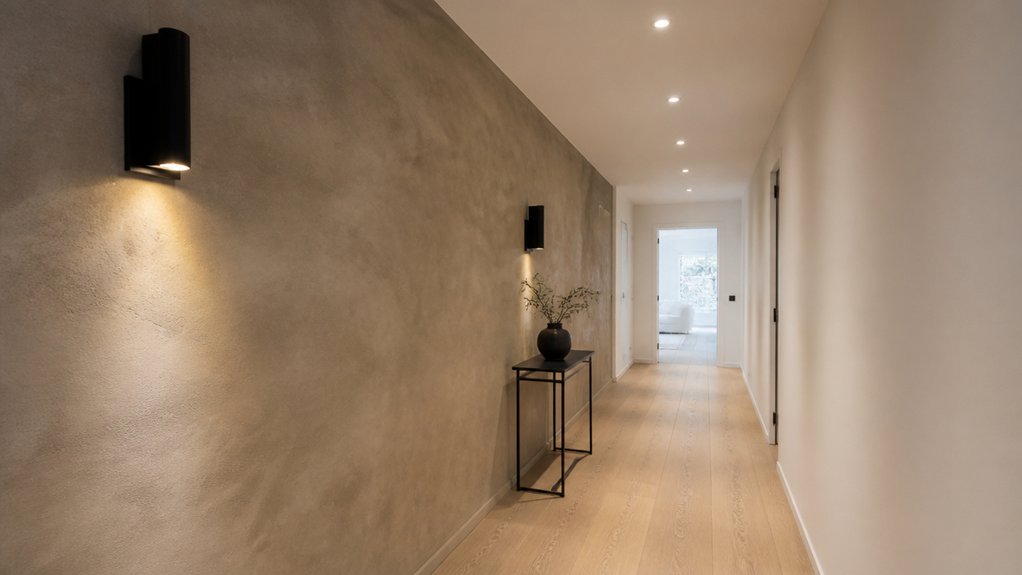
Where should you put a feature wall in a hallway so it looks intentional rather than random? Start by standing at your front door and noting what you see first; that surface is your natural focal point.
In most UK homes, the best choice is the wall at the end of the hall, as it draws the eye forward and makes the space feel longer.
If your hallway turns, feature the short return wall you face as you round the corner, not the long run you walk alongside.
Keep visual balance by avoiding walls broken up by too many doorways, radiators, or meter boxes. Choose one clear plane, then let skirting, architraves, and lighting lead you to it.
Check sightlines from stairs too.
Choose a Hallway Feature Wall Style (Paint, Paper, Paneling)
Once you’ve chosen the wall, decide whether paint, wallpaper, or panelling will do the heavy lifting, because each option changes not just the look but the practicality in a high-traffic UK hallway.
Paint gives you quick colour contrast and is easy to touch up after scuffs from coats, buggies, or school bags.
Wallpaper delivers stronger pattern selection, but you’ll want a wipeable vinyl or scrubbable finish, especially near the front door.
Panelling (MDF, tongue-and-groove, or shaker) adds texture and hides knocks; finish it with durable eggshell or satinwood for easy cleaning.
- Paint: test swatches in daylight and under warm bulbs.
- Wallpaper: match repeats carefully; buy an extra roll.
- Panelling: seal edges and caulk joints for a crisp line.
Use a Feature Wall to Fix Hallway Proportions
If your hallway feels too long, too narrow, or oddly low, you can use a feature wall to rebalance the proportions without moving a stud. Put the feature on the end wall to visually “stop” a long run and improve spatial perception as you enter.
To widen a tight corridor, run your feature horizontally: low panelling, a dado rail with a continuous band, or long-format wallpaper. Keep skirting and architraves consistent so the line reads cleanly.
For a low ceiling, take vertical elements up: slim battens or a tall panel grid that draws the eye upward, supporting proportion balancing.
If one side feels heavy (doors, meters, radiators), feature the opposite wall to even the visual weight. Always centre patterns to the hallway’s main sightline.
Pick Paint Colors That Add Hallway Depth
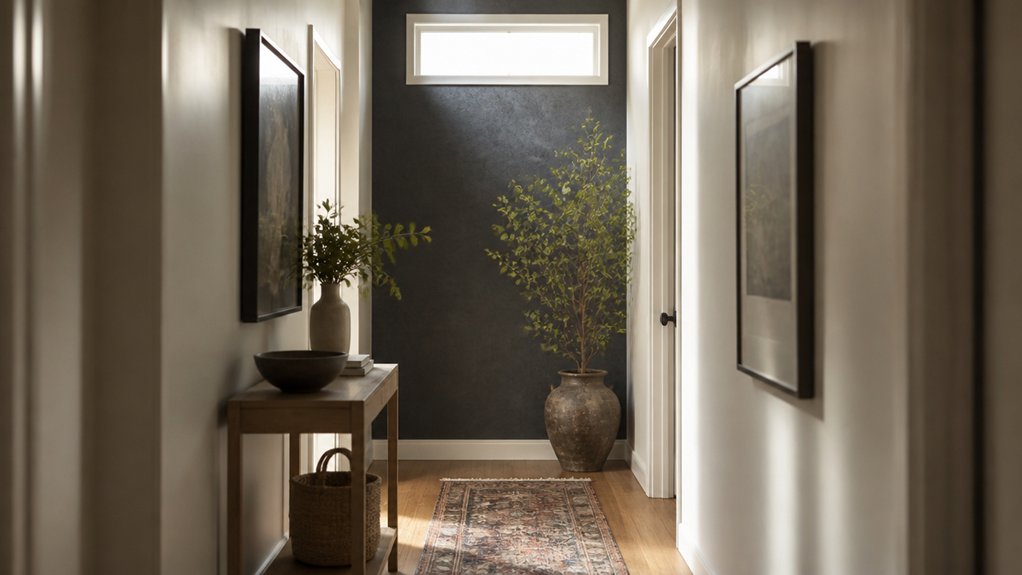
Although a hallway rarely gets much daylight, you can still create real depth with paint by controlling how light and shade sit along the run. Start by testing swatches under your bulbs at night; LEDs can shift undertones. Use Color contrast to pull focus to a feature wall, but keep tonal harmony on adjacent walls so the space doesn’t feel chopped up.
- Paint the end wall 2–3 shades darker than the side walls to visually shorten a long corridor and add punch.
- Choose a warm mid-tone for side walls and a lighter ceiling to bounce light back down the passage.
- Use crisp white (or a softer off-white) on skirting, architraves, and doors to sharpen edges and boost definition.
Make Hallway Feature Wall Wallpaper and Murals Work
Because hallways tend to be narrow and light-starved, you’ll get the best results from wallpaper or a mural when you treat it like a controlled focal point rather than a full wraparound scheme. Put it on the end wall, the wall opposite the front door, or the stretch you see from the stairs, then keep adjacent walls plain.
Choose smaller-scale patterns for short halls; go bolder only if you’ve got a clear sightline. For mural themes, pick calm landscapes, architectural sketches, or soft geometrics that elongate the space.
Use lighting techniques to avoid glare: fit warm-white LED picture lights, angle adjustable spots along the ceiling line, and test samples under evening bulbs. Seal edges and align repeats carefully.
Add Texture With Wood Slats or Wall Paneling
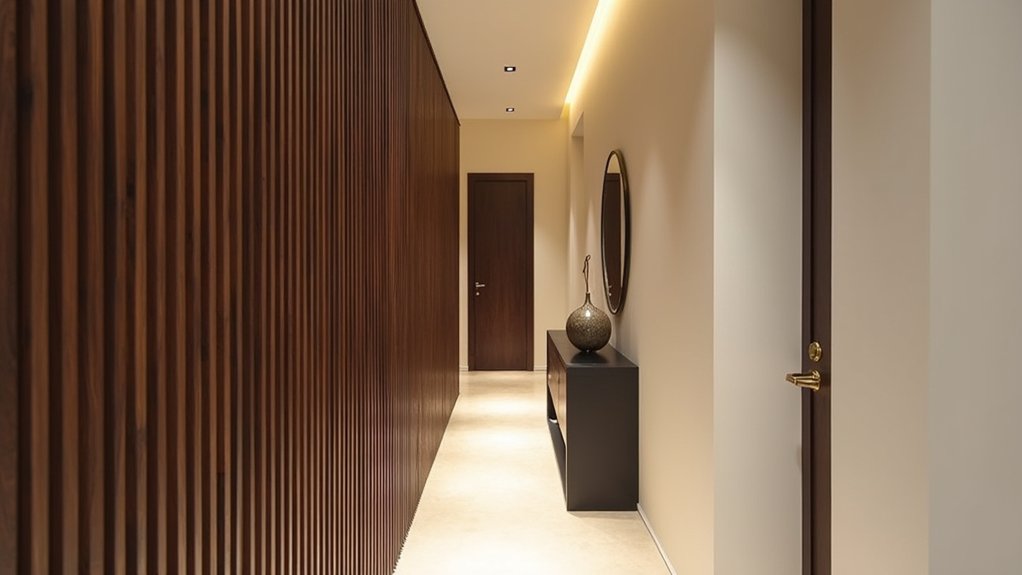
- Pick a profile: vertical slats elongate narrow halls; shaker-style panelling adds structure at dado height and protects walls from scuffs.
- Plan proportions: set slat spacing evenly (often 10–20mm gaps), and stop short of sockets and radiators for a neat fit.
- Finish for real life: use wipe-clean eggshell paint, or clear lacquer on timber; seal cut edges to handle damp coats and muddy trainers.
Light and Style the Feature Wall Without Clutter
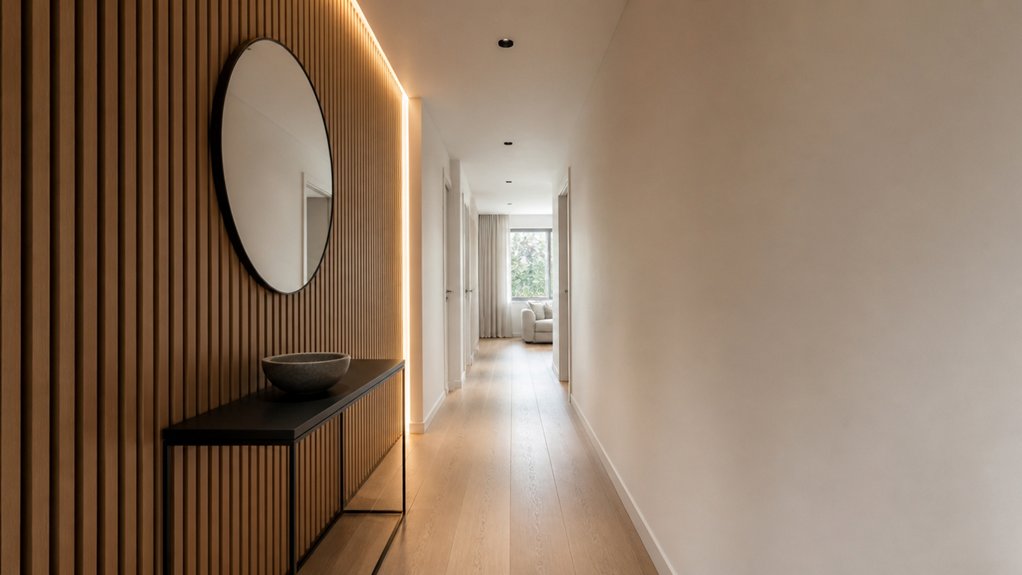
You’ll get the best result by layering your lighting—pair a slim ceiling fitting with a wall light or picture light to wash the feature wall evenly.
Keep the look sharp with clean lines: conceal cables, choose narrow-profile fittings, and stick to one finish (black, brass, or chrome) so it reads intentional.
Style it with minimal décor—a single framed print, a small ledge, or a mirror—so the hallway stays clear but the wall still makes maximum impact.
Layered Lighting, Clean Lines
Even if your hallway’s short on space, layered lighting can make a feature wall look intentional without adding visual clutter. Start with ceiling lighting to set an even ambient glow, then add targeted layers that highlight texture, colour, or panelling.
- Base layer: Fit a slim LED flush or small downlights on a dimmer, so you can soften brightness for evenings.
- Wall layer: Use discreet accent fixtures like up/down sconces or picture lights, centred to wash the feature evenly without harsh hotspots.
- Guidance layer: Add low-level LED strip under a dado rail, behind a handrail, or along skirting to lead the eye and reduce shadows.
Keep fittings in one finish (brushed brass, black, or chrome) and conceal drivers in a cupboard or loft.
Minimal Decor, Maximum Impact
Once your lighting layers are doing the heavy lifting, keep the styling on your hallway feature wall stripped back so it reads bold, not busy. Aim for one focal piece: a round mirror, a slim picture ledge, or a single oversized print.
Stick to a tight palette so colour contrast comes from the wall finish, not lots of objects. If you’ve chosen dark panelling or a saturated paint, use pale frames and matte black fixings for crisp edges.
Protect visual balance by spacing items evenly and keeping them centred on the sightline from the front door. Leave at least a hand’s width between pieces, and stop clutter by limiting hooks to a small rail.
Hide keys in a lidded tray on a narrow console.
Conclusion
Use a feature wall to make your hallway feel purposeful, not just a passage. You’ll get the best result by choosing the right wall, matching the finish (paint, wallpaper or panelling) to your light levels, then using colour and texture to correct proportions. For example, in a typical Victorian terrace in Leeds, painting the end wall a deep inky blue and adding slim vertical battens, lit by a warm wall sconce, made a long corridor feel shorter and smarter.
About the Author