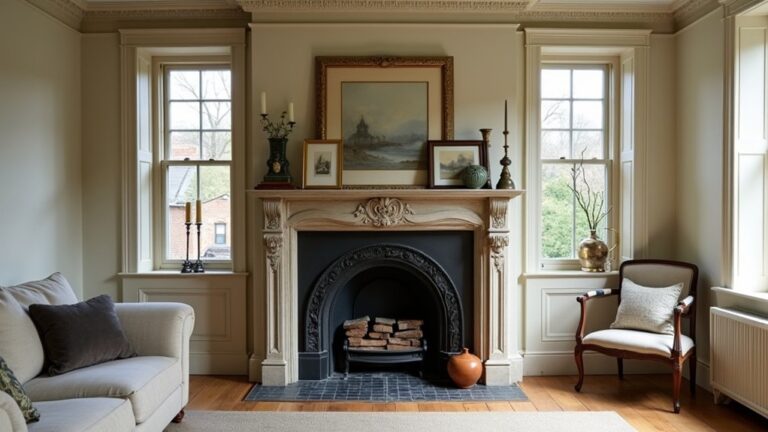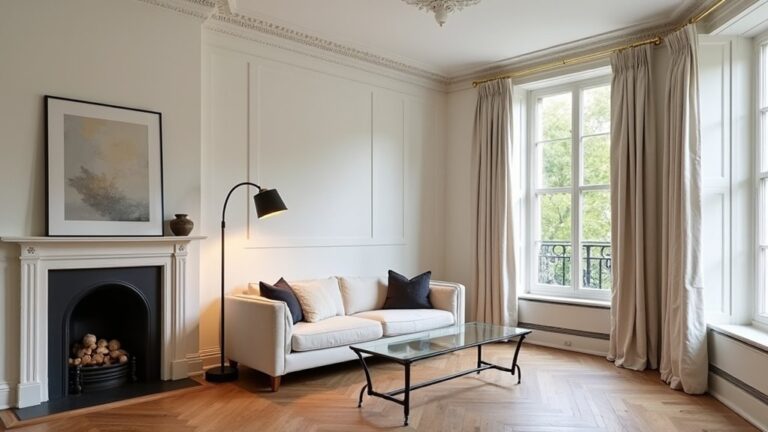
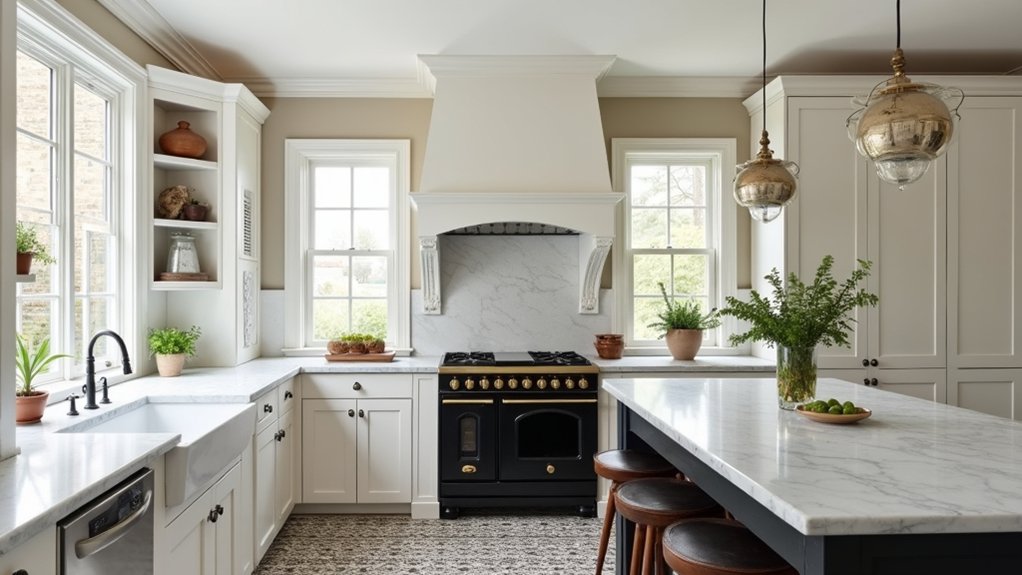
You’re threading a needle through two centuries, and every choice has to pass cleanly through. You start by setting a clear ratio—often 70/30—so modern planes stay dominant while Victorian cues like cornice lines, encaustic-style tile, and aged brass act as punctuation. You map the layout around chimney breasts, tall sash windows, and narrow bays, then control ornament with consistent profiles and generous spacing. Next comes the palette, because one wrong tone will tip the balance…
Key Takeaways
- Set a 70/30 modern-to-Victorian ratio, repeating two authentic Victorian motifs twice while keeping the rest minimal and functional.
- Choose a quiet neutral base plus one heritage hue, and repeat the palette at least three times with consistent sheen.
- Plan around existing Victorian architecture, protect circulation paths, and zone work areas near service lines, using a scullery/pantry as a buffer.
- Use period-resonant materials with simple profiles: honed stone counters, muted subway/hex/encaustic tile, and restrained trim repeated on cabinets, windows, and doors.
- Select “jewelry” elements and lighting carefully: bridge faucet, apron-front sink, limited mixed metals, and gasolier-inspired layered lighting with modern-efficient appliances.
Pick Your Modern Vs Victorian Ratio (70/30 Rule)
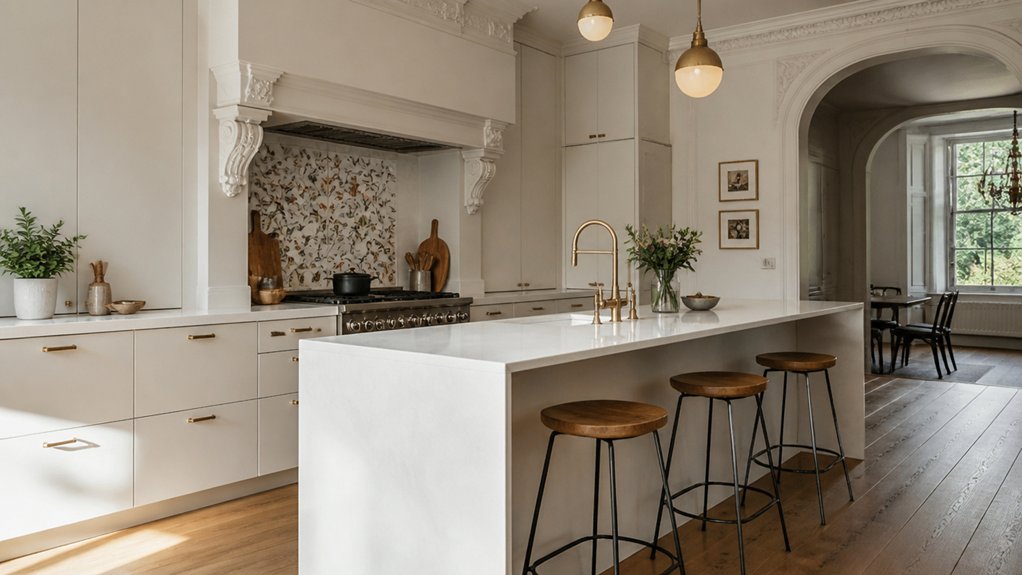
If you decide on your modern‑to‑Victorian ratio before you choose finishes, you’ll keep the room from sliding into a theme set or a sterile showroom. Use the 70/30 rule as a governor: let 70% read as Modern minimalism—flat or Shaker fronts, simple hardware, consistent slab backsplash, and restrained lighting geometry.
Reserve 30% for Victorian embellishments that feel authentic, not pasted on: a modest cornice, reeded glass in a few uppers, a subtly patterned encaustic-style inset, or a painted range surround with period-appropriate trim. Keep the Victorian moves concentrated and repeat them twice so they look intentional.
Then edit: if a detail doesn’t earn function or history, you don’t add it.
Plan a Layout That Fits a Victorian Home
Because most Victorian kitchens were carved out of narrow rear rooms and service corridors, you’ll get a better result by designing around the house’s bones instead of forcing a contemporary “great-room” plan. Start by mapping existing doors, chimney breasts, windows, and stair runs, then place work zones where services already sit to preserve Historical accuracy and reduce rerouting costs.
Protect the main passage from back entry to dining room; that’s your baseline for Spatial flow. Keep clear widths through pinch points, and use the scullery or pantry as a buffer for noisy appliances and bulk storage.
If you need an island, choose a slim prep table that keeps circulation intact. Where walls must move, widen openings rather than erase them, so the house still reads as Victorian.
Keep the Mix Clean: Lines, Ornament, and Spacing
Although modern cabinetry and Victorian detailing can share a room, they clash fast when you don’t control the visual “noise.” Start by choosing one dominant language—clean, flat planes or period-style frames—and let the other play a supporting role in smaller moves, like hardware, lighting, or a single run of uppers.
Keep profiles disciplined: if you use ogee doors, skip extra crown buildup; if you go slab fronts, limit molding to a simple frieze. Practice ornament reduction by repeating only one historic motif (bead, reeded pilaster, or bracket) and dropping the rest.
Maintain spacing consistency: align stiles, drawer reveals, and open shelves to one grid, and keep gaps even around ranges and hoods. Finally, match line weights—thin rails with slim pulls, heavy frames with substantial knobs.
Choose a Color Palette That Bridges Both Eras
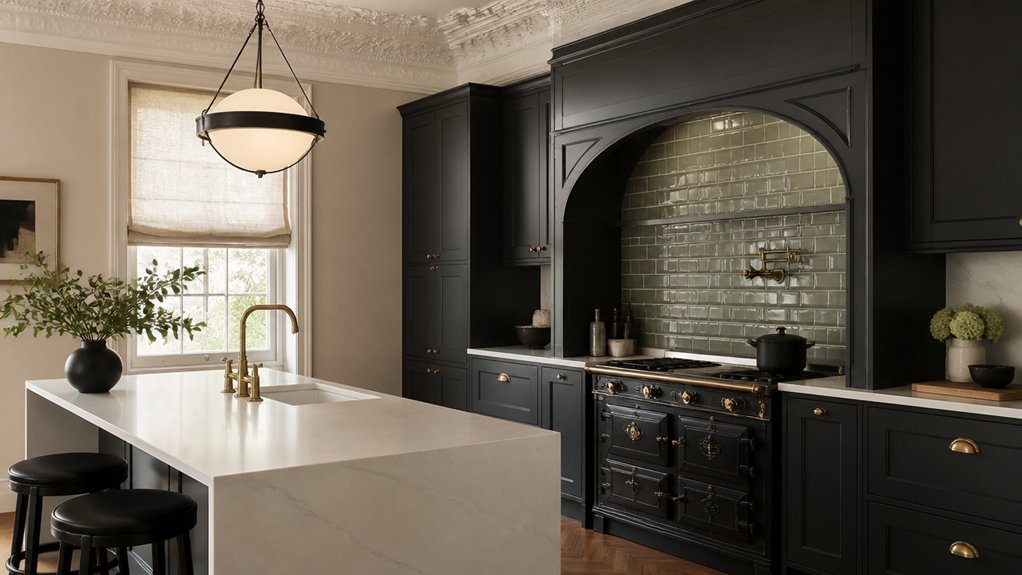
Once you’ve disciplined the lines and kept ornament from competing, color becomes the tool that makes modern planes and Victorian references read as one room. Start with a quiet base—warm white, stone gray, or inky charcoal—tones Victorians used to flatter gaslight, yet they still suit today’s crisp geometry.
Then control palette contrast: pair one heritage hue (sage, oxblood, Prussian blue) with one modern neutral, and repeat it at least three times for Color harmony. Keep sheen consistent so the room feels intentional, not patched together.
- You feel calm in a softened, candlelit base.
- You sense history in a deep, dignified accent.
- You get clarity from restrained, modern neutrals.
- You enjoy surprise in a single saturated note.
- You trust the plan when every hue repeats.
Blend Materials: Wood, Stone, Metal, and Tile
Start with warm wood—oak or walnut fronts echo Victorian joinery—then anchor them with stone counters or a simple slab backsplash to keep the room crisp and workable.
Keep metals disciplined: pick one primary finish for faucets and pulls, then use a secondary accent (aged brass with black iron, or nickel with stainless) so fixtures read intentional rather than mismatched.
For tile, you can pair a small-format field (subway or penny rounds) with one larger-scale pattern or border, mixing eras by shifting scale instead of crowding competing motifs.
Pair Warm Wood With Stone
Two materials can do most of the heavy lifting when you’re balancing modern restraint with Victorian warmth: warm wood and stone. Choose quarter-sawn oak or walnut for cabinetry or open shelving; their tight grain nods to late-19th-century joinery while reading clean.
Pair it with honed marble, soapstone, or limestone on counters and backsplashes so the surface feels calm, not glossy. Keep edges simple, but let the materials show honest wear. Then soften the hard planes with rustic charm and vintage textiles—runner rugs, café curtains, or seat pads—so the room doesn’t feel museum-stiff.
- You’ll feel grounded by wood’s familiar warmth.
- You’ll trust stone’s cool, steady permanence.
- You’ll savor patina that tells a lived-in story.
- You’ll enjoy quieter mornings in a calmer palette.
- You’ll sense history without sacrificing function.
Balance Metal Finishes Thoughtfully
Because Victorian kitchens rarely matched metals perfectly, you don’t need a single finish to make a modern space feel historically credible—you need a clear hierarchy.
Pick one “workhorse” metal finish for the largest items: faucet, cabinet pulls, and range knobs. Let it read as your baseline, then add one supporting finish for secondary pieces like lighting, pot rails, or shelf brackets.
To keep design cohesion, repeat each finish at least twice and separate roles: polished nickel feels period-correct and bright, while unlacquered brass develops patina that nods to age.
Use blackened iron sparingly for contrast, not as a third dominant.
If you’re adding stainless appliances, treat them as neutral and bridge them with nickel or chrome nearby.
Mix Tile Patterns And Scales
Once you’ve set a clear hierarchy in metal finishes, let tile do the same kind of work by controlling pattern and scale. Victorian kitchens loved busy encaustic floors and crisp field tiles; modern rooms prefer calm planes. You can bridge both with Tile pattern combinations that read intentional, not chaotic.
Use scale contrast: pair a small mosaic with a large-format slab so each gets breathing room. Keep one surface “quiet” (usually the countertop splash) and let another carry the ornament (often the floor or range wall). Repeat one color across patterns to tie wood, stone, and metal together.
- You’ll feel grounded by a heritage-inspired floor.
- You’ll breathe easier with a clean subway backdrop.
- You’ll savor sparkle from a thin metallic trim.
- You’ll trust the room’s rhythm when repeats align.
- You’ll smile when old-world detail meets modern calm.
Cabinets and Trim That Feel Period-Right (Not Fussy)
Start with Shaker-style doors for their honest, early-19th-century simplicity. Then layer in a few Victorian cues—like a narrow bead, a subtle ogee edge, or a modest inset panel—so the room reads period without feeling busy.
Keep trim profiles restrained: use flat-stock casings with a small backband, simple crown, and a consistent reveal to match historic millwork proportions.
Finish with paint and hardware pairings that look authentic and wear well—creamy whites or muted greens with unlacquered brass, aged nickel, or iron pulls in classic shapes.
Shaker Doors, Victorian Details
If you want your kitchen to nod to the Victorian era without drifting into gingerbread fussiness, pair plain Shaker doors with a few period-right details that do the heavy lifting. You’ll get shaker simplicity up front, then let carefully chosen Victorian embellishments add warmth and memory.
Stick to flat-center panels, tight reveals, and simple rails; then refine with hardware and finish that feel late‑19th‑century, not theme‑park.
- Choose bin pulls or small knobs in aged brass for a steady, heirloom touch.
- Add inset beading on select doors to quiet the room with craft.
- Paint in inky green, warm cream, or oxblood for moody comfort.
- Use furniture-style feet on an island to ground the space emotionally.
- Keep open shelving minimal so the calm stays intact.
Trim Profiles With Restraint
While Victorian houses often carried layered millwork, your kitchen reads more authentic when you scale the trim back and let a few correct profiles do the work. Choose one primary casing and one crown profile, then repeat them on uppers, windows, and doors so the room feels built-in rather than decorated.
Aim for crisp, late-19th-century shapes—ovolo, small bead, or a simple cyma—kept shallow to suit modern cabinet lines. Use ornamental trim only as a punctuation mark: a restrained light rail, a modest toe-kick molding, or a narrow frieze above a focal run.
Skip stacked crowns and multiple backbands. You’ll get period-right shadow lines, plus subtle embellishments that won’t compete with clean surfaces.
Paint And Hardware Pairings
Because paint and hardware read as “original” faster than almost any other finish, you’ll get the most period-right (not fussy) result by pairing a historically grounded cabinet color with simple, weighty metal. Choose muted Victorian-leaning hues—cream, sage, smoky blue, oxblood—then keep color coordination tight with trim in a half-step lighter or matching enamel.
Let texture contrast do the modern work: satin cabinets against semigloss trim, or a soft-matte island with crisp casing. Skip ornate backplates; use bin pulls or plain knobs in unlacquered brass, aged bronze, or iron, sized generously for that sober, workshop feel.
- A calm, steady palette that feels inherited
- Hardware that clicks with reassuring heft
- Trim that frames, not shouts
- Patina that forgives daily living
- A room that feels quietly “right”
Countertops + Backsplash That Unify the Look
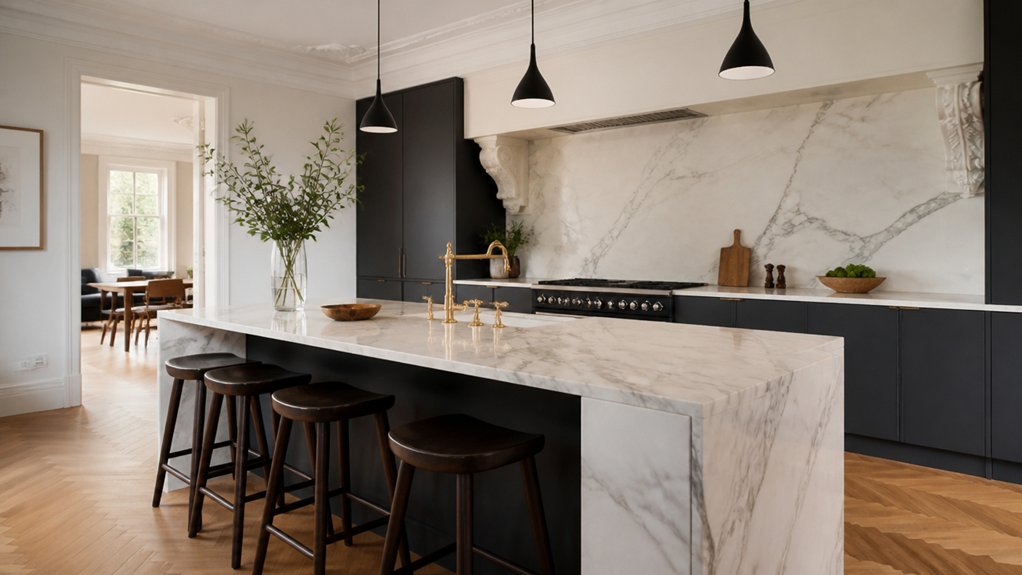
To make a modern kitchen sit comfortably beside Victorian cues, you’ll get the cleanest through-line by treating the countertop and backsplash as one coordinated surface rather than two competing statements.
Start with countertop material choices that nod to period restraint: honed marble or soapstone reads authentic, while quartz in a quiet veined pattern delivers durability without looking synthetic. Keep the edge profile simple; Victorian rooms loved substance, not gimmicks.
Then match it with backsplash tile styles that echo late‑19th‑century craft—cream subway, small hex, or muted encaustic motifs—but keep the layout disciplined with tight grout lines and a limited palette. Run the backsplash to the uppers or hood for a purposeful, architectural finish.
If you mix patterns, vary scale, not color.
Hardware, Faucet, and Sink: Your “Jewelry” Layer
Now you’ll lock in the era with your “jewelry” layer: period-appropriate mixed metals on pulls, knobs, and lighting that echo Victorian practice without looking fussy.
Choose a bridge faucet for its historically rooted silhouette, then match its finish to one anchor metal and let a second metal show up in smaller touches for a controlled mix.
Finish with an apron-front sink—fireclay for a classic look or stainless for modern function—so the work zone feels authentic and hardworking.
Period-Appropriate Mixed Metals
When you mix metals in a Modern–Victorian kitchen, treat the hardware, faucet, and sink as your “jewelry” layer—pieces that should look collected with intention rather than matched by default. Start with period appropriate hardware in unlacquered brass or aged nickel, then add one quieter counter-metal—oil-rubbed bronze or polished chrome—to echo modern lines.
Keep finishes in the same “age”: either all softly worn or all crisp, so nothing looks newly bolted onto history. Limit yourself to two, maybe three, metals across knobs, pulls, and lighting trim, and repeat each at least twice.
- You’ll feel grounded when patina tells a story.
- You’ll sense calm when contrasts stay disciplined.
- You’ll enjoy surprise when mixed metal accessories catch light.
- You’ll trust the room when tones relate to your wood.
- You’ll smile when every touchpoint feels intentional.
Bridge Faucets And Aprons
Mixed metals set the tone, but the faucet and sink seal the story because they’re the pieces you touch and study up close.
Choose bridge faucets to echo late‑Victorian plumbing: exposed crossbar, separate hot/cold handles, and a high spout that reads authentic, not themed. Keep it crisp by selecting a streamlined silhouette and a restrained finish—polished nickel feels period-correct yet clean beside modern counters.
Apron sinks bring the scullery sensibility Victorians loved, but you’ll want modern performance. Pick fireclay for a historically familiar look, then specify a deeper basin, sound-deadening, and a gently radiused interior for easier wiping.
Align the apron reveal with your cabinet lines, and pair it with a simple deck plate to prevent splash marks.
Lighting + Appliances That Look Right and Work Hard
Although cabinetry and trim set the tone, lighting and appliances determine whether your modern–Victorian kitchen actually functions day to day. Choose fixtures that nod to gasoliers and early electrics—opalescent glass, aged brass, and slender chains—then layer an ambient glow with discreet task illumination under shelves and uppers so prep feels effortless.
- You’ll feel calmer when shadows don’t pool on the cutting board.
- You’ll trust the room when dimmers soften dinner without glare.
- You’ll smile when a quiet hood disappears behind a mantel-style surround.
- You’ll cook longer when an induction range hides in a classic enamel face.
- You’ll relax when the fridge panels read like furniture, not machinery.
Prioritize modern efficiency: sealed burners, easy-clean ovens, and high-CRI LEDs that flatter stone and paint.
Five Finishing Rules to Avoid the “Two Kitchens” Look
Good lighting and hard-working appliances can carry the daily load, but the finish choices decide whether the room reads as one coherent kitchen or two eras competing for attention. Follow five rules.
First, pick one metal family and keep it consistent; mix only within a warm or cool range.
Second, limit wood species and sheen; Victorian ornamentation prefers depth, so use satin, not high gloss.
Third, keep your stone or solid-surface palette quiet; let one veined slab echo period marble without shouting.
Fourth, repeat a single profile: match Shaker rails to simplified beading so Modern minimalism can sit beside heritage joinery.
Fifth, cap ornament: choose one focal detail—corbels, hood trim, or tile frieze—and keep the rest plain throughout.
Conclusion
If you follow the 70/30 rule and keep profiles consistent, you won’t end up with a “split‑personality” kitchen—you’ll get a room that respects your home’s bones and meets modern life. Particularly, the UK’s Victorian housing stock still accounts for roughly one in five homes, so you’re not designing for a niche; you’re solving a common, historic layout. Use restrained ornament, period-leaning “jewelry,” and layered lighting, and the blend will feel inevitable.
About the Author